“Desire Isn’t the Villain—Misunderstanding It Is”: Adrian Chiarella’s Leviticus Turns Horror Into a Powerful Exploration of Queer Identity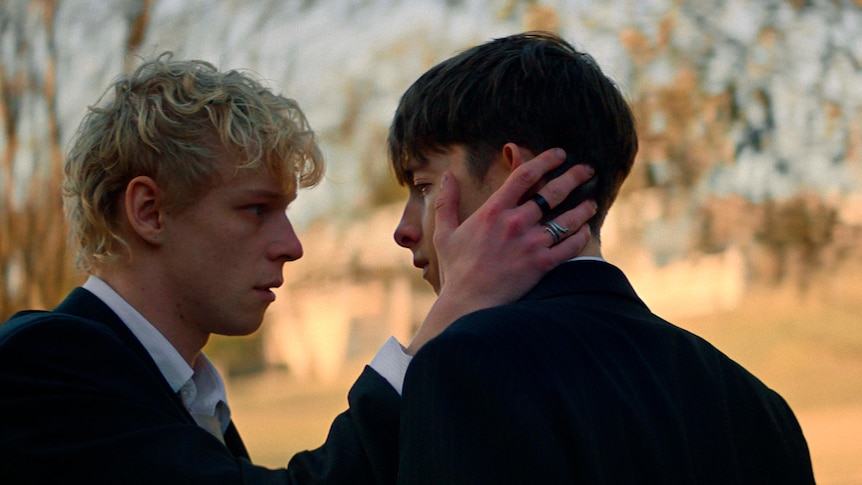
What happens when the person you are most drawn to becomes the very thing that threatens your survival? Not in the everyday sense of romantic frustration or relationship conflict, but as a literal danger—a force capable of destroying you. This unsettling question sits at the heart of Leviticus, the striking feature-film debut from writer and director Adrian Chiarella.
Combining psychological horror, social commentary, and queer coming-of-age storytelling, Leviticus presents a chilling examination of desire, repression, and identity. While the film contains supernatural elements and frightening imagery, its true horror lies in the social and emotional forces that attempt to control who people are allowed to love and how they are expected to live.
Chiarella has emerged as a provocative new voice in independent cinema, and his debut has already sparked significant discussion. Adding to the conversation, the filmmaker recently fueled online debate through a mysterious social media video that many interpreted as a reflection of the themes explored in his work. The cryptic imagery and emotionally charged tone led some viewers to speculate that the boundaries between the creator and his creation may not be as clear-cut as they initially appeared.
Whether intentional or not, the response highlights one of the film’s greatest strengths: its ability to provoke uncomfortable but meaningful conversations about temptation, fear, shame, and self-acceptance.
The title Leviticus immediately signals the film’s thematic ambitions. Named after the biblical book frequently cited by those seeking religious justification for anti-LGBTQ+ attitudes, the film confronts the legacy of exclusion and condemnation that many queer individuals continue to face.
Rather than approaching these issues through straightforward drama, Chiarella filters them through the language of horror.
At the center of the story are two young men, Naim and Ryan. Naim is portrayed by Joe Bird, whose breakout performance in Talk to Me earned widespread recognition, while newcomer Stacy Clausen plays Ryan. Their relationship begins tentatively, marked by uncertainty, awkwardness, and the vulnerability that accompanies self-discovery.
As the story unfolds, viewers watch the pair gradually navigate feelings they struggle to fully understand. What starts as friendship slowly evolves into attraction. Casual physical interactions become charged with emotional significance, and moments of hesitation give way to genuine affection.
Their connection feels authentic precisely because it is imperfect. Neither character possesses complete confidence in who they are or what they want. Instead, they stumble forward together, learning how to embrace their identities while confronting the pressures surrounding them.
However, the environment in which they live is far from accepting.
The film is set in a working-class Australian town characterized by industrial landscapes, modest homes, and deeply conservative values. Smoke rises from factory stacks, dogs bark behind fences, and daily life unfolds beneath the influence of a rigid religious culture.
Within this setting, conformity is not merely encouraged—it is expected.
A local pastor and a so-called “deliverance healer” play significant roles in maintaining the town’s social order. Their influence reinforces the belief that heterosexuality is the only acceptable path, creating an atmosphere where difference is treated as something dangerous or shameful.
It is within this context that the film introduces its supernatural element.
Following exposure to conversion therapy—a practice widely discredited by medical and psychological experts—the young men find themselves haunted by a terrifying entity. Rather than appearing as a traditional monster, the demon takes a far more psychologically disturbing form.
It manifests through desire itself.
The creature adopts the appearance of the object of one’s affection, transforming attraction into a source of fear. Longing becomes a weapon. Intimacy becomes dangerous. Love becomes intertwined with terror.
This concept elevates Leviticus beyond conventional horror storytelling. Rather than relying solely on jump scares or graphic violence, the film explores how social shame can distort natural human emotions. The demon becomes a metaphor for internalized fear and the damaging belief that desire itself is something wrong.
One particularly powerful line captures this tension perfectly when one character tells the other, “You shouldn’t be near me. I shouldn’t be near you.”
The statement reflects more than physical danger. It embodies years of conditioning that teach individuals to fear their own feelings. The horror arises not simply from the supernatural threat but from the emotional consequences of repression.
Chiarella demonstrates a strong understanding of horror cinema’s history while developing his own creative voice. The film opens with an unmistakable homage to Alfred Hitchcock, featuring a shower sequence that recalls the tension and vulnerability of Psycho. Elsewhere, viewers may recognize influences from classic supernatural horror films such as A Nightmare on Elm Street.
Yet despite these references, Leviticus never feels derivative.
The filmmaker occasionally employs symbolism that may strike some viewers as overly direct. Images such as a snake consuming a frog leave little room for interpretation. However, these moments are outweighed by the film’s confident pacing and effective atmosphere.
Chiarella carefully escalates the tension throughout the narrative, allowing dread to build gradually rather than overwhelming the audience from the outset. This measured approach makes the eventual horror sequences significantly more impactful.
Considering the film’s independent origins, its production quality is particularly impressive. The project even secured an unexpected endorsement from acclaimed musician Frank Ocean, who granted permission for the use of his song “Self Control.” The inclusion of such a beloved track adds emotional resonance while underscoring the film’s themes of longing and vulnerability.
While the supernatural creature provides the movie’s most obvious scares, the true villains are arguably the adults who surround Naim and Ryan.
Parents, community leaders, caregivers, and friends become sources of pain rather than protection. Through rejection, judgment, and intolerance, they contribute to an environment that teaches young people to fear themselves and each other.
One especially heartbreaking aspect of the film is its portrayal of conditional acceptance. A parent may express affection through small everyday gestures, demonstrating care in seemingly meaningful ways. Yet that same parent may refuse to accept a fundamental part of their child’s identity.
This contradiction lies at the core of the film’s emotional impact.
The adults are not presented as cartoonishly evil figures. Instead, they embody the real-world systems and beliefs that perpetuate shame. Their actions reveal how love can become distorted when it is constrained by prejudice.
Perhaps the film’s greatest achievement is its portrayal of first love.
Amid the horror, suspense, and social critique, Leviticus remains deeply invested in the emotional reality of its protagonists’ relationship. Chiarella captures the exhilaration of discovering mutual attraction, the nervous anticipation of physical intimacy, and the overwhelming vulnerability that accompanies emotional openness.
The stolen glances, tentative touches, and hesitant kisses feel remarkably genuine. These moments provide a powerful counterbalance to the film’s darker elements, reminding viewers what is at stake.
Joe Bird and Stacy Clausen deserve considerable praise for bringing these emotions to life. Their performances communicate not only the specific experiences of queer youth but also the universal feelings associated with falling in love for the first time.
Fear, hope, excitement, uncertainty, and longing transcend individual identities, making the characters’ journey accessible to a broad audience.
Ultimately, Leviticus succeeds because it refuses to simplify its themes. Desire is neither portrayed as inherently good nor inherently dangerous. Instead, the film argues that the real threat emerges when people misunderstand, suppress, or weaponize it.
By blending horror with emotional authenticity and social commentary, Adrian Chiarella has created a debut feature that is both deeply unsettling and profoundly human. It challenges audiences to reconsider their assumptions about morality, temptation, and identity while delivering a gripping cinematic experience.
In the process, Leviticus establishes Chiarella as a filmmaker willing to confront difficult questions—and one whose future work will undoubtedly be watched with great interest.