On the day of my father’s funeral, I still believed the greatest mystery in my life was simply a missing Versace dress.
The deep blue dress, its fabric turning nearly black under dim light and shimmering silver when the hand-sewn crystals on the collar caught the sunlight. My father had given it to me for my fortieth birthday last fall, accompanied by a card that read: “For those nights when you need to remember that elegance is the armor that protects you.” That was how my father wrote – always florid and dramatic, like a lawyer with strong opinions about every button.
Three weeks before the funeral, I had searched everywhere for the dress but could not find it. By the morning of the funeral, losing the dress seemed entirely unimportant. My father had passed away. The house was filled with casserole dishes, hushed voices, and coffee cups gone cold on the stove. White lilies stretched across the kitchen counter, their sweet scent mixed with the wilting smell, creeping into every corner like sorrow made visible.

I wore black because black is simple, and I did not trust myself with anything fragile.
St. Augustine Church was cool and dim as I entered, filled with the scent of candle wax, stone, and stained-glass light. The organ hummed beneath whispered conversations. Shoes clacked on marble floors. Shaking hands clutched damp tissues. Men loosened their ties before the service had even begun. My father had known nearly half the city, and it seemed as though all of them were present.
I paused for a single breath at the back.
At the front, my father’s coffin lay beneath white roses and blue delphiniums. Father Martinez was speaking quietly with Mr. Blackwood – my father’s lawyer and closest friend. Aunt Helen was organizing the attendees with an expression that suggested she was prepared to prevent any disruption. None of this felt like my life. It felt as if I had stepped into a play loosely based on my own existence, yet the main character had been replaced without my knowledge.
And then I saw my husband.
Grant was seated exactly where he should have been – in the family row.
But the woman beside him had no right to be there.
She was wearing my dress.
In a blinding moment, my mind refused to accept the evidence. I watched the crystals glitter under the colored light as she turned her head, casting flashes of red, blue, and gold across the polished wood of the pew ahead. My father used to joke that the dress was so expensive it almost produced its own light. Now it was shining on another woman’s body while my father lay less than six meters away.
I began walking toward them before I had fully decided what to say.
“Rebecca,” I said, my voice strangely calm. “What are you doing here?”
Rebecca Thornton turned with a composed smile that made my hands itch with anger.
She was about twenty-eight, perhaps twenty-nine if one were generous, and worked in marketing at Grant’s company. I had met her twice at corporate events. She called me Natalie in an overly enthusiastic tone – the kind certain women use when they seek praise for friendliness without offering sincerity. She had glossy brown hair, expensive cheek fillers, and a talent for lingering too close to married men.
“Natalie,” she said gently, as though this were a casual brunch encounter rather than my father’s funeral. “I’m so sorry for your loss.”
Her hand was tightly holding Grant’s – not merely resting near it, but with fingers intertwined.
Grant looked up at me, and the expression on his face struck me harder than any surge of anger. It was not confusion. It was not surprise. It was guilt.
The church seemed to shrink around us. The air grew metallic, like the taste of blood after biting one’s cheek. All the late nights at work, the sudden business trips, the shortened or extended journeys with excuses about clients, mergers, and red-eye flights – everything suddenly fell into place so rapidly that I nearly stumbled.
“Why is she wearing my dress?” I asked.
No one answered.

That silence was answer enough.
Rebecca crossed one leg over the other and gave a small shrug. The hem slid across her knee, and I could see she had already altered the waist.
“Oh, this?” she said. “Grant gave it to me. He said you never wore it.”
I turned to Grant. His eyes immediately avoided mine. After fifteen years of marriage, he still believed that refusing to look directly at a problem counted as a strategy.
“Tell me she is lying,” I said.
“Natalie,” he muttered, leaning forward as if trying to calm a disruptive child in church. “Not here.”
Those words struck me harder than any shout. “Not here.” As though my reaction was the inappropriate element, not the sight of his mistress seated in the family row at my father’s funeral, wearing the dress my father had given me for my birthday.
The service proceeded in a suffocating atmosphere. I sat two rows behind them, unable to focus on the prayers. Each glance forward revealed Rebecca sitting shoulder to shoulder with Grant, the dress sparkling as if mocking my grief. Grant kept his head lowered, his hands clenched tightly, sweat visible on his forehead despite the cool air inside the church.
After the coffin was carried out, the family moved to the lawyer’s office for the reading of the will. The atmosphere grew even heavier. Mr. Blackwood sat behind his large desk, opened the file, and began reading in a calm, steady voice.
He read the standard clauses: division of assets among the children and grandchildren, charitable funds my father had established, and small bequests to relatives. Then he paused, looked directly at me, and continued.
“To my daughter, Natalie,” Mr. Blackwood read clearly, his voice echoing in the silent room. “You called me yesterday to speak about your husband’s affair. I am deeply sorry that you must learn of this in this manner, but I could not allow you to continue living in deception. All of my personal assets designated for you – including the main house, investments, and savings accounts – shall be transferred entirely to you. Grant shall receive nothing from my estate. Be strong, Natalie. I have always been proud of you.”
The room erupted in shocked whispers.
Grant’s face turned deathly pale, all color draining from his skin. He opened his mouth but no sound emerged; his knuckles whitened as he gripped the arm of his chair. Rebecca beside him lost every trace of elegance. Her composed smile vanished, replaced by pure panic. She tried to pull her hand away from Grant’s, but he unconsciously tightened his grip, as if clutching at a final straw. The Versace dress on her body now appeared like cheap stage costume; the sparkling crystals only highlighted how out of place she looked amid the mourning and the harsh truth.
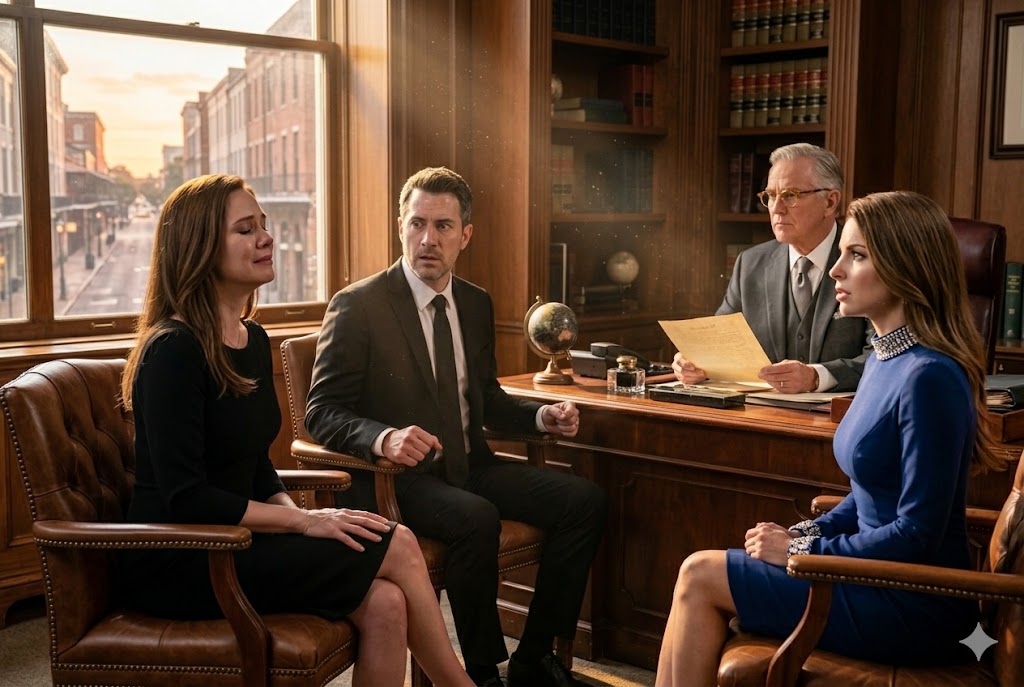
I sat motionless, tears streaming down my cheeks – not from sorrow, but from a profound sense of release. My father had known everything. He had prepared this final protection for me even after his death. The call I made to him yesterday, when suspicion had driven me to confide in him, had become his last weapon on my behalf.
Grant turned to me, his voice trembling. “Natalie… we can talk about this later, can’t we?”
I stood up and looked him directly in the eyes for the first time that day.
“There is nothing left to discuss, Grant. The will has said everything.”
Rebecca attempted to rise, but her legs faltered. She fumbled with the hem of the dress, suddenly aware that it did not belong to her. Several relatives began whispering her name, their glances filled with contempt.
Mr. Blackwood closed the file, his voice calm yet firm. “The reading of the will is concluded. Natalie, you may contact the office to complete the formalities.”
I walked out of the room without looking back. Outside, the afternoon sun bathed the churchyard in warm, bright light – warmer and brighter than it had felt in a long time. The Versace dress my father had given me no longer mattered. It was merely an object. My father had left me something far more valuable: the truth, protection, and the strength to begin anew.
Grant and Rebecca would now face the consequences of their actions. As for me, with the inheritance my father had secured and the memory of his love, I would continue forward. Elegance is not only armor – it is also the power to rise after betrayal.