BTS’S V AND JUNG KOOK WORRY ARMY AS TOUR PRESSURES TAKE A PHYSICAL TOLL
V AND JUNG KOOK’S CANDID COMMENTS ABOUT THEIR BODIES HAVE SENT A WAVE OF CONCERN THROUGH ARMY — BUT BEHIND THE DRAMATIC REACTION IS A FAMILIAR REALITY OF STADIUM-LEVEL PERFORMING: EVEN BTS CANNOT ESCAPE THE PHYSICAL COST.
For millions of BTS fans, seeing V and Jung Kook together on a livestream is usually an invitation to laugh, celebrate and enjoy the chemistry between two of the group’s most recognizable members.
But their latest candid conversation has prompted a very different reaction.
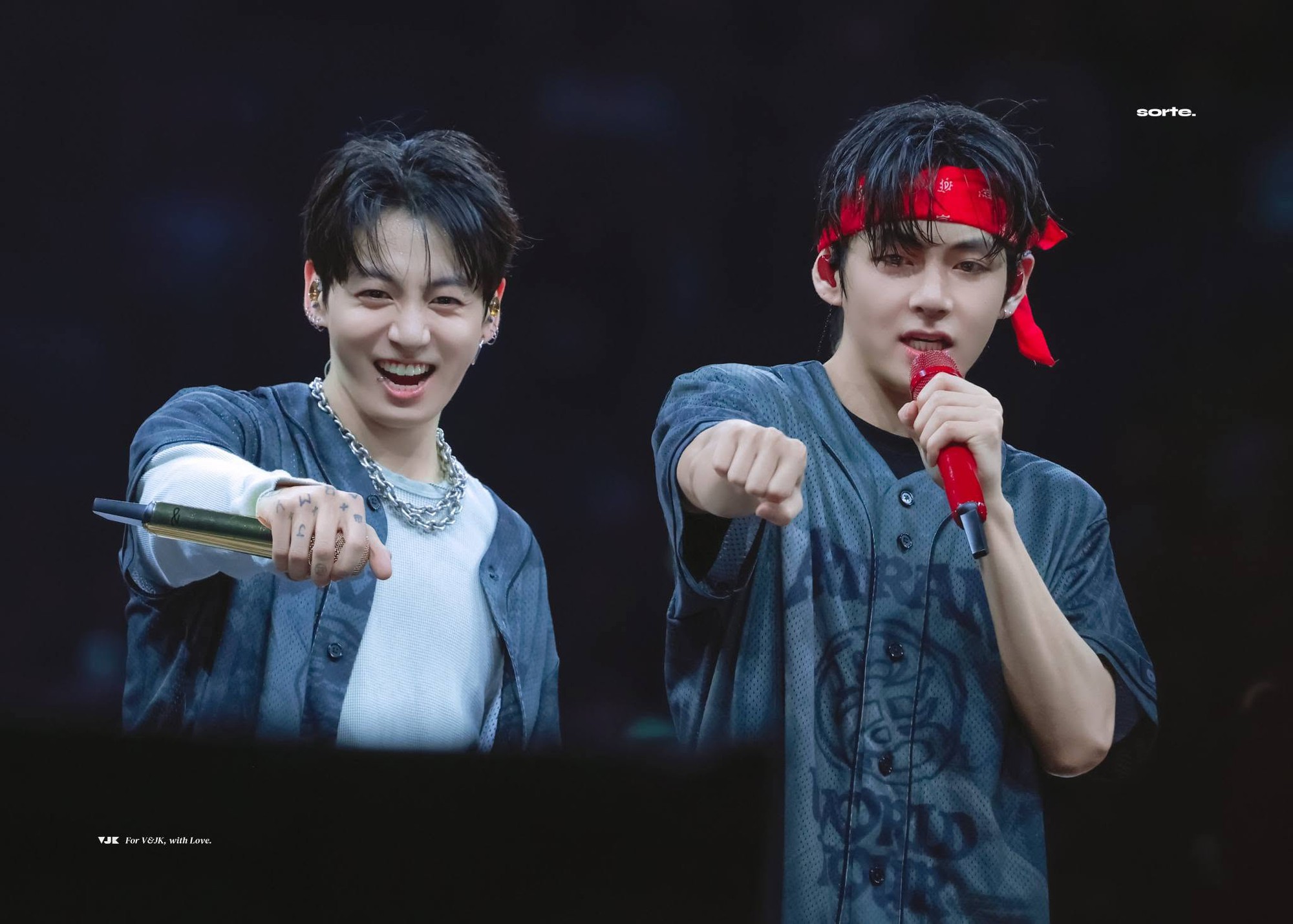
During a Weverse livestream, V—Kim Tae-hyung—and Jung Kook spoke about physical difficulties associated with performing, including discomfort involving in-ear monitors and the strain being placed on their knees.
Those comments were enough to send worried reactions racing across social media.
For ARMY, the concern is understandable.
BTS performances are rarely gentle affairs.
Their concerts combine demanding choreography, extended stages, rapid movement and the enormous adrenaline of performing in front of tens of thousands of people. Even an artist in excellent physical condition can feel the consequences after repeatedly putting the body through that workload.
Jung Kook’s comments about his knees therefore immediately attracted attention.
He has built a reputation as one of BTS’s most athletic performers, throwing himself into choreography with an intensity that has become part of his stage identity.
But that intensity comes with a price.

Jumping, landing, turning and repeatedly lowering the body during choreography can place substantial stress on the knees.
And when the same movements are rehearsed and performed again and again, fatigue can accumulate.
That does not automatically mean Jung Kook has suffered a serious injury.
There is an important difference between an artist discussing pain or physical strain and receiving a confirmed diagnosis of a significant medical condition.
Still, hearing him acknowledge discomfort inevitably worried fans who know how hard he performs.
V’s remarks produced a different concern.
In-ear monitors are essential pieces of equipment for major live performers.
They allow singers to hear a controlled audio mix despite the enormous volume generated by a stadium crowd, backing tracks, musicians and stage equipment.
But wearing them for extended periods can become uncomfortable.
For an artist performing night after night, even a relatively small issue involving an earpiece can become intensely distracting.
V’s willingness to discuss that discomfort gave fans another glimpse of what happens behind a polished concert performance.
From the audience, everything can look effortless.
The lights explode.
The choreography lands perfectly.
The members smile.
Thousands of voices sing together.
But backstage and between performances, the reality can involve sore joints, exhausted muscles, uncomfortable equipment and constant efforts to recover before the next show.
That is the side of touring audiences rarely see.
And it explains why V and Jung Kook’s comments struck such a nerve.
BTS’s return to large-scale group activities has carried enormous emotional significance after the members completed their mandatory military service.
Fans waited years for the seven members to reach the point where full-group activities could once again become possible.
That anticipation naturally creates an instinct to protect them now that they are back.
But concern can quickly turn into exaggeration.
Claims that V and Jung Kook are “breaking down” physically should therefore be treated cautiously unless supported by official medical information.
Neither comments about knee strain nor discomfort from in-ear equipment prove that either performer is facing a career-threatening condition.
There is also no basis for assuming that BTS is secretly approaching some catastrophic physical collapse.
What their remarks do reveal is much more ordinary—and perhaps more important.
They are tired human beings doing extraordinarily demanding work.
For Jung Kook especially, physical performance has always been inseparable from his appeal.
He does not simply stand at a microphone.
He dances while maintaining vocal control, moves across large stages and performs choreography requiring considerable endurance.
The knees absorb much of that impact.
Over a single concert, the strain may be manageable.
Across rehearsals, sound checks and repeated performances, however, recovery becomes increasingly important.
V faces his own demands.
His distinctive voice is central to BTS’s sound, meaning he needs to hear himself and the rest of the performance accurately while surrounded by extraordinary levels of noise.
An in-ear monitor that becomes painful or uncomfortable is therefore not simply an annoying accessory.
It is equipment he depends upon to perform.
The fact that both men were willing to mention these difficulties may actually offer some reassurance.
Artists acknowledging discomfort is preferable to pretending that nothing hurts until a manageable problem becomes worse.
Modern touring increasingly depends upon physiotherapists, trainers, medical staff and carefully structured recovery routines precisely because performers are effectively elite physical workers.
Rest matters.
Monitoring symptoms matters.
Adjusting choreography or equipment when necessary matters.
ARMY’s reaction also illustrates the unusually close relationship BTS has cultivated with its audience.
Through platforms such as Weverse, the members can speak to fans in an informal environment far removed from carefully edited television interviews.
That openness creates intimacy.
But it can also amplify anxiety.
A casual remark about soreness can travel across social media stripped of context and reappear minutes later as a frightening headline suggesting a medical emergency.
That is why the distinction between concern and confirmed crisis is so important.
Fans can reasonably hope Jung Kook protects his knees.
They can reasonably want V’s equipment adjusted so that he can perform comfortably.
They can also demand that touring schedules allow all seven members sufficient recovery time.
None of that requires assuming the worst.
The larger issue is the extraordinary expectation placed on global touring artists.
BTS does not merely have to perform songs.
Every concert carries the weight of years of anticipation.
Audiences expect spectacle.
They expect choreography.
They expect energy.
And because tickets can represent enormous financial and emotional investments for fans, performers can feel pressure to deliver at maximum intensity regardless of how tired they are.
The body, however, does not care about expectations.
A knee still absorbs impact.
An ear can still become irritated.
Muscles still need recovery.
Sleep still matters.
That may be the most important message hidden beneath V and Jung Kook’s candid comments.
The two stars were not necessarily announcing some dramatic medical catastrophe.
They were allowing fans to see the physical reality underneath the spectacle.
And perhaps that is exactly why the conversation became so emotional.
ARMY has spent years waiting to see BTS together again.
The last thing fans want is for that long-awaited return to come at the expense of the members’ health.
So the question—“Are they okay?”—is understandable.
But the responsible answer cannot come from frightening speculation.
Unless BTS or their representatives announce a specific medical diagnosis or change to scheduled activities, claims of a serious health crisis remain unsubstantiated.
What fans can do is listen to what V and Jung Kook actually say rather than turning every expression of discomfort into evidence of disaster.
Because the strongest performers are still capable of hurting.
The biggest stars are still capable of becoming exhausted.
And acknowledging physical limits does not make BTS weaker.
If anything, V and Jung Kook’s candor is a reminder that behind the stadium lights and seemingly superhuman performances are seven people whose health must matter more than delivering one more perfect night on stage.