The steps of the Metropolitan Museum of Art have seen countless legendary face-offs, but the 2026 Met Gala hosted a “Visual War” that will be studied by fashion critics for decades. Under the avant-garde theme of “Costume Art,” the red carpet became a high-stakes battlefield between the established titans of the 3rd generation and the skyrocketing icons of the 4th. While the world held its breath for the historic first-ever simultaneous appearance of all four BLACKPINK members, it was the strategic, art-focused debut of aespa’s Karina and Ningning that arguably stole the night’s most viral moments. The evening wasn’t just about “Fashion Is Art”—it was about a seismic shift in the Hallyu hierarchy, where the “Lemonade” energy of aespa met the veteran elegance of the Pinks head-on.
The Aespa Takeover: Karina and Ningning’s Surrealist Victory
Coming off the massive hype of their upcoming second full-length album, Lemonade, and an impending summer world tour, Karina and Ningning entered the Met Gala not as guests, but as a new standard of “Costume Art.” While they attended separately, their collective impact was undeniable, offering a fresh, provocative take on the evening’s dress code that made the veterans look almost safe by comparison.
Karina, aespa’s 26-year-old leader and the “Visual of the Generation,” delivered what many are calling the night’s most meaningful ensemble. Representing Prada, Karina didn’t just wear a gown; she wore a piece of history. Her custom white satin dress, draped under a voluminous black cape, was a sophisticated deconstruction of the traditional Korean hanbok. By referencing the Three Kingdoms period through the lens of modern Italian luxury, Karina achieved the ultimate goal of the Met Gala: merging heritage with high-art couture. Her look was a silent but powerful statement that Korean culture is the bedrock of modern fashion. With her bejeweled neckline and contrasting green and purple drop earrings, Karina looked less like an idol and more like a high-fashion deity, successfully outshining many of the night’s more seasoned attendees.

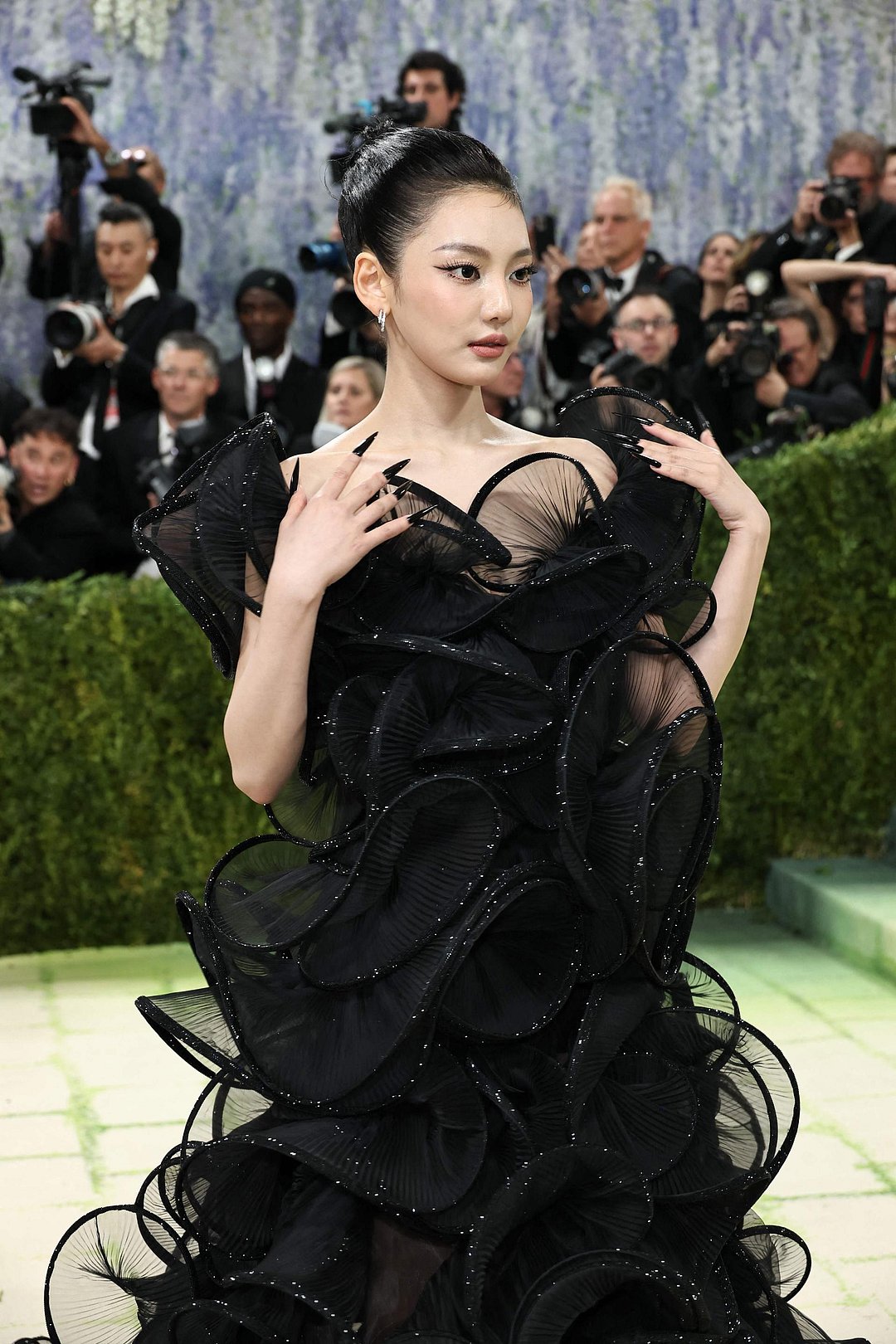
Beside her, Ningning solidified her new status as Gucci’s newest brand ambassador with a look that leaned into the “Dark Art” aesthetic. Dressed in a structural black creation by creative director Demna, Ningning moved away from the typical “idol” sparkle to embrace a raw, edgy silhouette that stood in sharp contrast to the evening’s more traditional floral gowns. Her presence alongside Karina signaled that aespa is no longer just “the next big thing” – they are the current “IT” girls who can handle the pressure of fashion’s most unforgiving stage.
The BLACKPINK Legacy: A Quartet Under Pressure
While aespa brought the “New Era” spark, BLACKPINK arrived as the reigning monarchs of the Met Gala, attempting to secure their legacy with a full-group appearance. This was the first time Lisa, Jennie, Jisoo, and Rosé were in the same room for the event, a move designed to show total group dominance.
Lisa certainly made a play for the “Best Dressed” title, serving as the first K-pop artist ever named to the Met Gala host committee. Her Robert Wun couture look was a surrealist masterpiece, featuring a dramatic veil held up by sculpted “extra hands” that seemed to emerge from her gown. It was a bold, historical moment, but some critics argued that the heavy sculptural elements lacked the effortless, cultural grace found in Karina’s hanbok-inspired Prada.

Jennie, the “Human Chanel,” leaned into the artisanal side of the theme. Her column dress was a feat of engineering, requiring 540 hours of manual labor and 15,000 embroidered details to create the illusion of blue sequined leaves. While the craftsmanship was beyond reproach, the internet was divided, with some fans feeling the look lacked the “shock factor” needed to compete with the avant-garde risks taken by the aespa duo.

Jisoo finally made her Met Gala debut as the face of Dior, closing the gap as the last member to attend. Her shimmering floral design and sculptural waist were classically beautiful, echoing her “Dior Princess” persona. However, in a night defined by “Costume Art,” her look felt traditional, allowing the more provocative silhouettes of Karina and Ningning to grab the headlines.

Rosé followed suit in a minimalist Saint Laurent black silhouette, which, despite its statement bird brooch, felt like a repetition of her past red carpet “safe” choices.

The Visual Verdict: Fresh Blood vs. Established Royalty
The comparison between the two groups dominated social media throughout the night. The story being told on the red carpet was clear: BLACKPINK came to defend their throne with 540-hour gowns and committee seats, but aespa came to disrupt it with “Lemonade” energy and cultural deconstruction.
Fans pointed out that while BLACKPINK’s looks were rooted in the “Luxury House” identity (Chanel, Dior, YSL, Celine), aespa’s Karina and Ningning seemed to interpret the “Costume Art” theme with more individualistic flair. Karina’s hanbok-inspired Prada was a masterclass in using fashion as a narrative tool, while Ningning’s Gucci look proved that the 4th generation isn’t afraid to be “ugly-chic” or experimental.
Adding another layer to this visual showdown was the presence of the stars from Netflix’s KPop Demon Hunters. Ahn Hyo Seop made a historic debut for Korean actors in Valentino, while Ejae and Audrey Nuna (the voices of Rumi and Mira) brought a silver-screen glamour to the event. Their presence served as a reminder that the Hallyu wave is no longer just about music—it is a multi-media empire that has completely taken over Western high society. Ahn Hyo Seop’s “global triple crown” (The Tonight Show, Oscars, and the Met) mirrored the meteoric rise of aespa, creating a sense that a new guard of Korean talent is finally ready to stand shoulder-to-shoulder with the BLACKPINK icons.

As the 2026 Met Gala concluded, the debate over who “won” the night remained fierce. BLACKPINK’s full-group reunion was a historic milestone that proved their longevity and massive industry power. However, in terms of sheer “buzz,” artistic risk, and visual impact, the debut of Karina and Ningning was the true conversation starter.
By blending traditional Korean elements with high-concept Prada and Gucci designs, aespa proved they are the new architects of “Costume Art.” They didn’t just attend the Met Gala; they challenged the status quo. As they prepare to drop Lemonade and embark on their world tour, Karina and Ningning have sent a clear message to the world: the era of playing it safe is over, and the new queens of the Met Gala have arrived. BLACKPINK may have the host committee seats, but tonight, aespa had the world’s eyes.