Netflix subscribers who spent the weekend falling in love with Tova Sullivan, Cameron Cassmore, and a surprisingly philosophical giant Pacific octopus have inevitably arrived at the same question: is Remarkably Bright Creatures actually based on a true story, or did someone simply imagine the most emotionally articulate sea creature ever put on screen?
The answer is straightforward. No, it is not based on real events. But the reasons people keep asking the question are far more interesting than a simple yes or no.
The short version is that Remarkably Bright Creatures, which premiered on Netflix on May 8, is a work of fiction. The longer version involves a viral aquarium video, a creative writing assignment, and an author who decided to give a lonely octopus a voice that somehow feels entirely real.
Despite the grounded setting and the deeply human grief at its center, nothing in Sowell Bay actually happened. The town itself, like the aquarium where much of the story unfolds, exists only in Shelby Van Pelt’s imagination. Yet viewers continue to assume otherwise, largely because everything in the story feels so lived-in that it resists the label of “made up.”
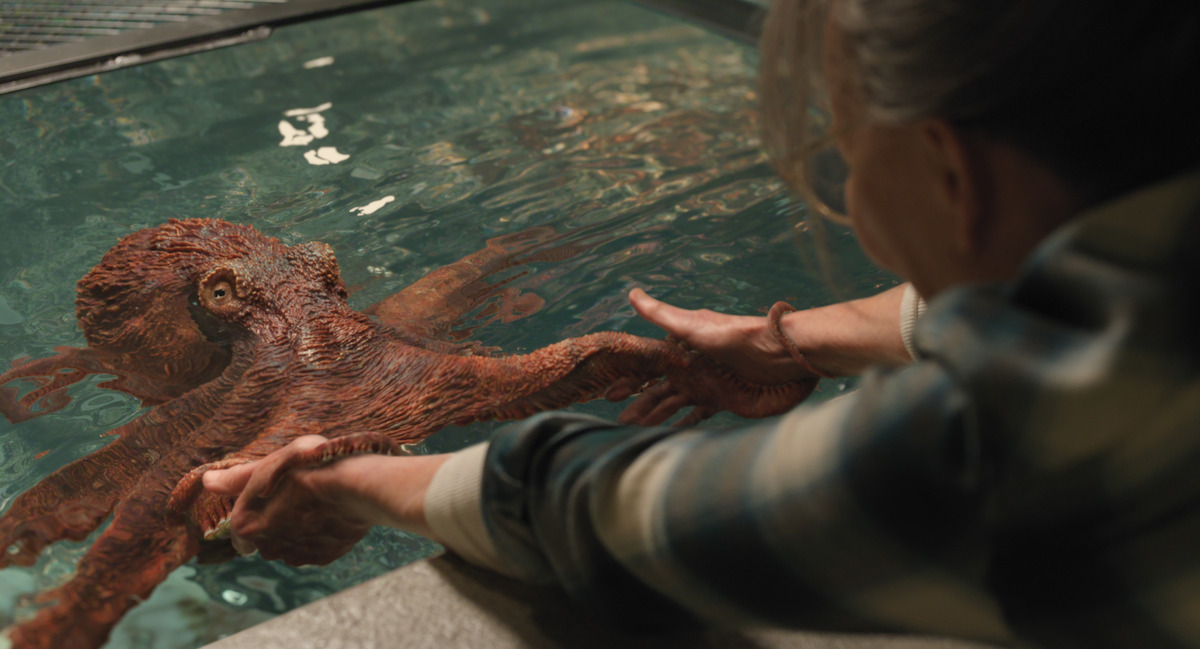
Part of that illusion comes from the science. Marcellus, the giant Pacific octopus voiced in the film by Alfred Molina, is not just a whimsical invention with poetic tendencies. He is built on real biological behavior. Octopuses really can open jars, navigate mazes, recognize individual humans, and escape enclosures with unsettling intelligence. That factual foundation gives Marcellus a credibility that makes his inner monologue feel less like fantasy and more like translation.

The film adaptation, directed by Olivia Newman, leans fully into that balance between realism and wonder. Sally Field plays Tova Sullivan, a night-shift cleaner at the Sowell Bay Aquarium grieving the loss of her son decades earlier. Lewis Pullman plays Cameron, a drifting young man searching for answers about his past. And at the center of it all is Marcellus, who quietly observes, judges, and occasionally manipulates the humans outside his tank.
Together, they form a trio that feels improbably connected but emotionally coherent.
The question of whether the story is real often begins with Marcellus himself.
The Viral Octopus That Started Everything
The origin of Remarkably Bright Creatures can be traced back to something far less cinematic than a Hollywood adaptation: a short internet video.
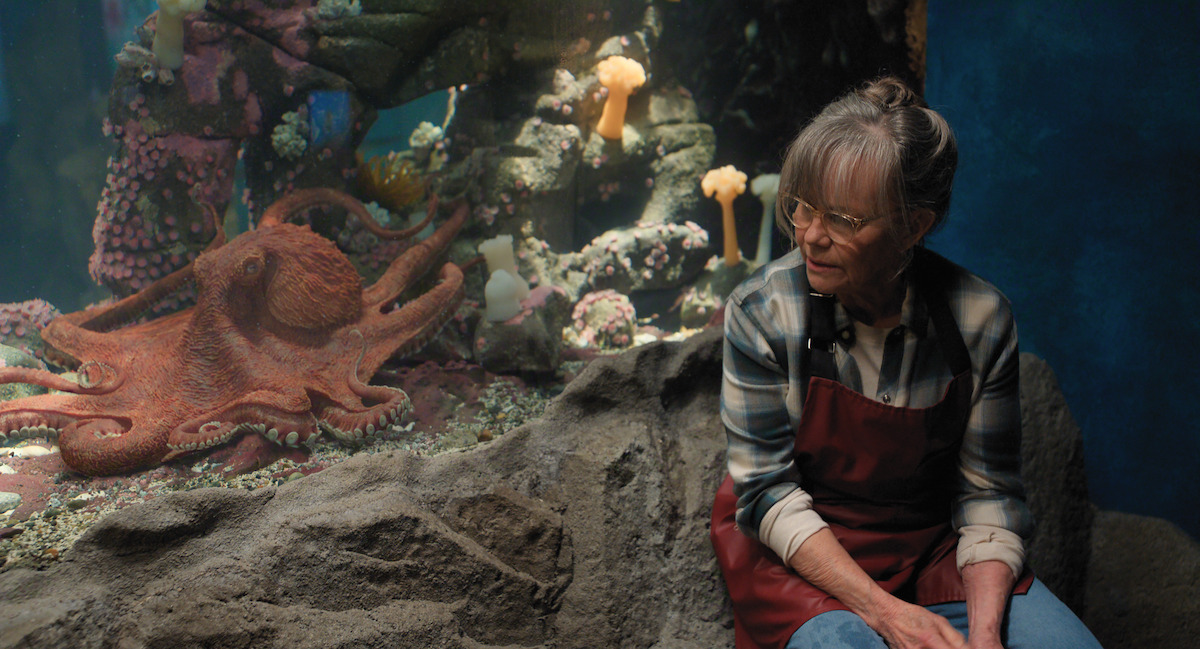
In interviews, Shelby Van Pelt has said that she first became fascinated by octopuses after watching a viral clip from the Seattle Aquarium showing one attempting to escape its enclosure. The behavior was oddly deliberate, almost calculated, and it lodged itself in her imagination.
That curiosity led her down a long research path into cephalopod intelligence. Octopuses are widely regarded by marine biologists as some of the most intelligent invertebrates on the planet, capable of problem-solving and exhibiting behaviors that sometimes look uncannily intentional.
From there, the idea didn’t immediately become a novel. It started, as many unusual stories do, in a writing class.
Van Pelt was given an exercise to write from an unexpected perspective. She chose an octopus. What began as a playful experiment quickly shifted tone when she started imagining the creature’s irritation with humans peering into its world. That voice—dry, observant, and faintly exasperated—eventually evolved into Marcellus.
What makes the character so convincing is that Van Pelt never treated him as pure fantasy. She grounded his narration in real scientific behavior, cross-checked details with marine biology references, and deliberately avoided turning him into a cartoonish “talking animal.” The result is a character who feels startlingly plausible, even when he is plotting elaborate escape plans.
Where The Humans Come From
If Marcellus is built from science, the human characters are built from memory.
Van Pelt has said that Tova Sullivan was inspired in part by her own grandmother, a woman whose quiet routines and emotional resilience left a lasting impression on her childhood. That influence is visible in Tova’s character, from her meticulous habits to the way she carries grief as something constant rather than explosive.
There is also a more personal layer. Van Pelt began writing the novel shortly after becoming a mother herself, and that experience informed Tova’s backstory—particularly the lingering pain of losing a child and the way that loss reshapes an entire lifetime.
Even Sowell Bay, the fictional coastal town where the story takes place, is rooted in real geography. Van Pelt grew up in the Pacific Northwest and has spoken about her visits to aquariums in the region, especially the quiet fascination of watching marine life drift behind glass.
Those real-world textures help explain why readers and viewers so often assume the story must be nonfiction. It feels remembered rather than invented.
From Page To Screen
When Netflix adapted the novel, it preserved that sense of realism rather than amplifying spectacle. The production filmed in Vancouver, blending real aquarium footage with carefully constructed visual effects to bring Marcellus to life without losing his physical presence.
In fact, the filmmakers reportedly worked with footage of a real giant Pacific octopus named Agnetha to ground Marcellus’ movements. CGI was then layered over those performances to allow for emotional timing and narrative precision.

The casting also reinforced the story’s grounded tone. Sally Field brings decades of lived-in emotional performance to Tova, while Lewis Pullman plays Cameron with a restrained vulnerability that mirrors the novel’s quiet pacing. Around them, a strong supporting cast including Joan Chen, Colm Meaney, Kathy Baker, Beth Grant, and Sofia Black-D’Elia helps build a community that feels fully inhabited rather than assembled.
The result is a film that doesn’t feel like fantasy pretending to be reality, but rather reality slightly tilted toward something more poetic.
Reception has reflected that balance. Critics have described the film as gentle, emotionally effective, and unexpectedly moving. While not every review has been glowing, audience response has been notably strong, with many viewers responding to the film’s understated tone and emotional restraint.
But the central misconception remains unchanged.
Is it real?
No. Not in the literal sense.
But that answer also misses the point.
The real foundation of Remarkably Bright Creatures is not an event, but a feeling: grief carried quietly over time, unexpected companionship forming in unlikely places, and the strange comfort of being observed—really observed—by something that seems to understand more than it should.
That emotional truth is what makes Marcellus believable. It is what makes Tova’s loneliness recognizable. And it is what makes Cameron’s search for belonging feel familiar even if his circumstances are not.
So while the story itself never happened, its impact absolutely has.
And for many viewers, the only question that matters now is not whether it’s real, but why it feels like it could be.
Because once you’ve heard an octopus narrate your grief back to you, reality starts to feel a little less certain anyway.