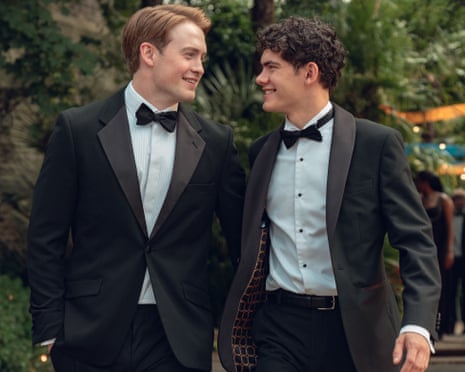
For more than three years, Heartstopper has stood apart as one of Netflix’s most beloved coming-of-age dramas, offering viewers a rare combination of optimism, emotional honesty, and unapologetic queer joy. Now, with the release of Heartstopper Forever, creator Alice Oseman officially closes the chapter on Nick Nelson and Charlie Spring’s story, bringing the franchise to an emotional conclusion that celebrates how far its characters—and its audience—have come.
Rather than returning for a traditional fourth season, Netflix chose to wrap up the adaptation with a feature-length film. While some fans initially questioned whether two hours could provide enough time to conclude a story that has unfolded over three acclaimed seasons, Heartstopper Forever largely succeeds in delivering a heartfelt farewell that remains true to everything that made the series special from the beginning.


From the opening moments, the film feels instantly familiar. The signature hand-drawn animations return, filling emotional moments with fluttering hearts, sparkling stars, colorful leaves, and whimsical doodles that have become synonymous with Nick and Charlie’s romance. Those charming visual flourishes once again remind viewers that, despite tackling difficult subjects, Heartstopper has always chosen hope over cynicism.
The story picks up after the events of season 3, with Charlie Spring entering his final year at Truham Grammar School in a dramatically different place than when audiences first met him. Once isolated, bullied, and afraid to be himself, Charlie has grown into one of the school’s most respected students. He’s elected Head Boy on an anti-bullying platform, reflecting just how much confidence he has gained following years of therapy and personal growth.
Nick, meanwhile, faces a different kind of uncertainty.
As university applications loom, he struggles to decide what comes next. Leeds University appears to be his likely destination, but the thought of leaving Charlie behind raises difficult questions neither of them is fully prepared to answer.
For the first time, the couple must seriously confront the possibility that love alone may not be enough to overcome distance, changing priorities, and adulthood.
That uncertainty forms the emotional backbone of the film.
Unlike previous installments that focused on coming out, public acceptance, or Charlie’s recovery from anorexia and obsessive-compulsive disorder, Heartstopper Forever shifts its attention toward growing up.
Nick and Charlie aren’t simply learning how to love each other anymore.
:max_bytes(150000):strip_icc()/Heartstopper_3-9ce6a6aa7fb746d0a8002acf2d2b75b9.jpg)
They’re learning how to become independent individuals without losing the relationship that has defined so much of their teenage lives.
Charlie throws himself into creating a Pride Club at school, hoping to offer younger LGBTQ+ students the same support he once desperately needed.
His mentorship of freshman Alfie becomes one of the film’s most rewarding storylines, illustrating how Charlie has transformed from someone who needed saving into someone capable of lifting others.
Nick’s journey proves equally compelling, though considerably quieter.
Throughout the series, Nick has often served as Charlie’s emotional anchor.
Now he begins asking uncomfortable questions about who he is beyond being Charlie’s caretaker.
Without someone to protect or fix, Nick feels strangely adrift.
That growing anxiety manifests itself in unhealthy ways.
He begins drinking too much at parties, withdraws emotionally, and struggles to communicate his fears.
The film also spends more time exploring Nick’s complicated relationship with his father, suggesting years of neglect and impossible expectations have left lasting emotional scars.
Kit Connor delivers perhaps his finest performance of the entire franchise here.
Where previous seasons often showcased Joe Locke’s emotional range, Heartstopper Forever belongs equally to Connor, who captures Nick’s quiet vulnerability with remarkable sincerity.
His performance never feels melodramatic.
Instead, Connor allows tiny expressions, hesitant pauses, and restrained emotion to communicate volumes.
Joe Locke remains equally impressive.
Charlie is noticeably more mature than the anxious teenager audiences first met, but Locke wisely avoids portraying him as completely healed.
Recovery isn’t presented as a destination.
It’s an ongoing process.
Charlie’s eating disorder and anxiety occasionally resurface, reminding viewers that healing isn’t always linear.
One of the film’s most touching sequences arrives during Charlie’s shift at the coffee shop where he works as a barista.
There, he quietly observes an elderly gay couple enjoying each other’s company.
Played by Sir Derek Jacobi and his real-life husband Richard Clifford, the pair have been together for decades.
Their brief appearance becomes one of the movie’s most meaningful moments.
Without lengthy speeches, they represent the future Charlie secretly hopes he and Nick might someday share.
The message is simple but powerful.
Queer love isn’t limited to adolescence.
It can endure.
That hopeful perspective echoes throughout the entire film.
Another emotional highlight belongs to Jenny Walser’s Tori.
As Charlie questions what a lifelong relationship should look like, his sister offers one of the movie’s most memorable observations.
She explains that her own asexual relationship doesn’t resemble society’s traditional expectations, but that doesn’t make it any less meaningful.
Her reminder that happiness doesn’t require fitting into conventional definitions of romance perfectly reflects one of Heartstopper’s central themes.
Every relationship is unique.
What matters is that it works for the people living it.
Beyond the central romance, the supporting cast once again brings warmth and authenticity.
Yasmin Finney, William Gao, Corinna Brown, Kizzy Edgell, Leila Khan, Rhea Norwood, Tobie Donovan, and the rest of the ensemble continue to feel like genuine friends rather than television archetypes.
That chemistry has always been one of the show’s greatest strengths.
However, it also highlights the film’s biggest weakness.
Simply put, there isn’t enough time.
Compressing what might have been an eight-episode season into a single feature inevitably leaves several beloved characters with limited development.
Darcy’s nonbinary journey receives only brief attention.
Tara and Darcy’s relationship is largely summarized rather than explored.
Isaac, despite becoming one of the franchise’s most important sources of asexual representation, spends much of the film in the background.
Even Tao and Elle’s evolving relationship occasionally feels rushed, with certain emotional transitions happening off-screen.
None of these storylines are mishandled.
They simply deserve more breathing room than the film can provide.
It’s difficult not to imagine how much richer these arcs might have become across a full season.
Fortunately, when the spotlight remains on Nick and Charlie, Heartstopper Forever rarely misses a beat.
One especially moving conversation between the couple forces both boys to confront fears they’ve avoided for months.
Instead of relying on dramatic misunderstandings or unnecessary conflict, the screenplay emphasizes honest communication.
Even during their lowest moments, audiences never doubt how deeply these characters love one another.
Perhaps the film’s most unforgettable speech belongs to Yasmin Finney’s Elle.
As Charlie hesitates about attending a Pride march, Elle passionately explains why visibility still matters.
She admits she’s frightened by increasing hostility toward transgender people and worries about losing rights generations fought to secure.
Her plea isn’t framed as political rhetoric.
It’s deeply personal.
She simply wants the freedom to exist without fear.
The speech resonates precisely because it reflects the realities many LGBTQ+ young people continue to face today.
It’s a reminder that while Heartstopper often presents an optimistic vision of acceptance, that optimism exists alongside genuine social challenges.
The film never loses sight of hope, but neither does it ignore reality.
As the story approaches its conclusion, Nick tells Charlie, “I love knowing that we have tomorrow.”
The line encapsulates everything Heartstopper has always stood for.
Love isn’t about certainty.
It’s about choosing each other despite uncertainty.
The final scenes beautifully reinforce that message.
Rather than promising a perfect future, they suggest that Nick and Charlie now possess the emotional tools needed to face whatever comes next together.
It’s an ending that feels earned rather than manufactured.
Alice Oseman’s writing has consistently balanced sweetness with authenticity throughout the series, and Heartstopper Forever continues that tradition.
The film understands that growing up means embracing change instead of fearing it.
Graduation represents both an ending and a beginning.
Although longtime viewers may wish they could spend several more seasons with these characters, stopping here feels emotionally appropriate.
Nick and Charlie’s story has never been about fairy-tale perfection.
It’s been about learning that love requires honesty, patience, vulnerability, and growth.
For many LGBTQ+ viewers, Heartstopper has offered something television rarely provides: a coming-of-age story where queer teenagers are allowed happiness without sacrificing realism.
Its impact extends far beyond entertainment.
The series has become a source of comfort, validation, and hope for audiences around the world.
Older viewers may even find themselves mourning the teenage experiences they never had, imagining what life might have looked like in a world where openness and acceptance were possible.
That emotional resonance explains why saying goodbye feels so bittersweet.
While Heartstopper Forever may not have enough time to fully resolve every supporting storyline, it succeeds where it matters most.
It gives Nick and Charlie the ending they deserve.
More importantly, it reminds audiences why they fell in love with these characters in the first place.
As the credits roll, viewers are left with the comforting belief that first love doesn’t have to be fleeting.
Sometimes, with enough courage, compassion, and commitment, it really can last forever.