Remarkably Bright Creatures is one of those movies that sneaks up on you, seemingly unremarkable at first glance, but leaving an emotional impact that lingers long after the credits roll. Based on the bestselling novel by Shelby Van Pelt, the film has arrived on Netflix, and while it may not break new ground in terms of storytelling, it is a gentle, heartfelt drama that taps into universal themes of loneliness, healing, and unexpected connections. The film’s release brings a timely return to one of Hollywood’s most revered actresses, Sally Field, who has largely stayed out of the limelight in recent years.
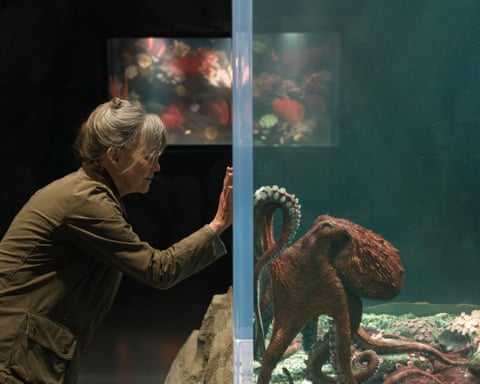
At the heart of Remarkably Bright Creatures is Tova (Sally Field), an elderly woman working as a cleaner at a small aquarium in a picturesque coastal town. Tova is no stranger to grief, having lost her son many years ago, and the wound still runs deep. She keeps to herself, preferring solitude, a lifestyle she shares with Marcellus, an elderly octopus in the aquarium. Tova is the one person in the aquarium who seems to understand him, offering comfort and conversation to the lonely sea creature. Marcellus, voiced by Alfred Molina, doesn’t care for humans—understandable, given that he’s been trapped in a tank for most of his life—but he finds solace in Tova’s presence.
The setup feels deceptively simple, but it taps into a deeper emotional core. Both Tova and Marcellus are isolated, and the bond between them is poignant. Tova’s life revolves around the memories of her lost son, and Marcellus is a silent witness to her grief. Their relationship sets the stage for the film’s exploration of healing through connection, with the unlikely friendship between the human and the octopus offering solace in ways words cannot.
Field’s performance as Tova anchors the entire film. Known for her Oscar-winning roles in Norma Rae and Forrest Gump, she brings her trademark emotional depth to a role that could have easily become a caricature of the grieving widow. As Tova, Field makes the character both relatable and deeply affecting, allowing the audience to feel the weight of Tova’s loss without overplaying the melodrama. The chemistry she shares with Marcellus, despite the octopus being a non-human character, is incredibly touching.
Tova is not just a typical “older woman character”; she is given room to wrestle with her past, her grief, and her future. Field’s nuanced portrayal elevates the film, making Tova’s journey one that feels personal and deeply universal. In an industry that often sidelines older female characters, Remarkably Bright Creatures gives Field the opportunity to explore a complex character without resorting to clichés or patronizing tropes.

Lewis Pullman plays Cameron, a young musician who, after his van breaks down in the coastal town, starts working at the aquarium alongside Tova. His arrival initially disrupts Tova’s solitary routine, but as they spend more time together, they realize that they share more in common than they expected. Cameron is struggling with his own grief, dealing with the death of his father and his inability to find his footing in life.
Pullman brings depth to the role, portraying Cameron as a lost soul who is just beginning to understand the importance of human connection. The film’s emotional heart lies in the unlikely friendship between Cameron and Tova, two people who have been deeply scarred by life but who find solace in each other. Their bond is slow-burning, but ultimately transformative for both characters.
Pullman’s performance, though solid, is more understated compared to Field’s powerhouse presence. While he may not have as much screen time to showcase his range, his portrayal of Cameron is empathetic and well-suited to the film’s overall tone. Cameron’s journey is a quieter one, and Pullman nails the subtleties of his character’s emotional evolution.
It’s hard to imagine that an octopus would play such a pivotal role in a film, but Remarkably Bright Creatures somehow makes it work. Alfred Molina’s voice performance as Marcellus is both charming and oddly poignant. The octopus is not merely a bystander in the story; he becomes a character in his own right, observing Tova’s interactions and providing her with the kind of companionship she doesn’t receive from other people. Marcellus may not be able to speak, but his presence is felt throughout the film, and Molina’s voice work imbues the octopus with personality and depth.

Marcellus is also a symbol of Tova’s emotional growth. As she opens up to him and slowly lets him into her world, she begins to process her grief and move forward. It’s a testament to Molina’s vocal performance that Marcellus becomes an integral part of the emotional journey, even though he is a non-human character. The film’s decision to make the octopus a focal point is unexpected, but it pays off, adding an extra layer of warmth and whimsy to the otherwise somber narrative.
The beauty of Remarkably Bright Creatures lies in its simplicity. The plot is not complicated, nor does it attempt to pack in unnecessary twists or excessive drama. Instead, it focuses on the quiet, emotional moments between characters as they navigate their pain and learn to open up to others. The film’s pacing is deliberate, taking its time to explore the complexities of grief, friendship, and healing. Director Olivia Newman, known for Where the Crawdads Sing, brings a softer touch here, opting for a quieter, more introspective approach that suits the material well.
However, the film does have its flaws. Some of the romantic subplots, especially with Colm Meaney and Sofia Black D’Elia, feel underdeveloped and somewhat extraneous. While they add to the narrative, they don’t carry the same weight as the main character arcs. Additionally, some of the more sitcom-like moments between the characters can feel forced, detracting from the film’s otherwise grounded tone. That said, the movie manages to recover with its emotional payoff, which makes up for some of the minor missteps.
By the time the film reaches its conclusion, it has built a genuine emotional connection with the audience. While it may not deliver the kind of tearjerking finale it clearly aims for, the ending is still emotionally satisfying. The film succeeds in making the audience care about its characters and their growth, and the final moments are poignant without feeling manipulative.
Remarkably Bright Creatures may not be a groundbreaking film, but it is a solid, heartfelt drama that benefits from strong performances, particularly from Sally Field. The unexpected inclusion of Marcellus the octopus adds an endearing layer to the story, and while the film doesn’t always hit the emotional beats it strives for, it still delivers a satisfying, heartwarming experience.
For those seeking a gentle, thought-provoking film about grief, connection, and unexpected friendships, Remarkably Bright Creatures is worth the watch. It’s not a perfect film, but it’s one that leaves you feeling better than when you started, and in the world of streaming content, that’s sometimes all you need.
Remarkably Bright Creatures is now available to stream on Netflix.