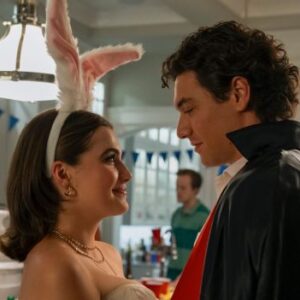
Episode 7 of The Boys Season 5 does something relatively rare for a series built on escalation: it pauses long enough to let an ending feel final rather than merely shocking. Now streaming on Prime Video, the episode marks the emotional conclusion of Frenchie’s arc, delivering a death that is less about spectacle than about quiet inevitability, and more about connection than collapse.
Frenchie, played by Tomer Capone, has always existed within a delicate emotional register in the series—defined by loyalty, remorse, and an almost persistent softness that contrasts sharply with the brutality of the world around him. In this episode, that softness becomes his defining strength and, ultimately, his final vulnerability. His last stand against Homelander is not framed as a heroic attempt to win, but as a refusal to step away from the people he refuses to abandon.

The confrontation itself is stark. Frenchie attempts to intercept Homelander before he can reach Kimiko and the rest of the team, fully aware of the imbalance between them. Even after deploying radiation in a desperate attempt to weaken the most powerful supe in existence, he is overpowered with little ambiguity. The sequence avoids dramatizing the mechanics of the fight and instead focuses on its emotional consequence: the certainty that this was always going to end one way, and yet it mattered that he chose to stand there regardless.
What follows is the episode’s most restrained and intimate moment. Before dying from his injuries, Frenchie shares a final kiss with Kimiko, played by Karen Fukuhara. The gesture is not framed as narrative closure in a conventional sense, but as recognition—an unspoken acknowledgment of everything the two characters have endured together. In a series often defined by extremes, the moment stands out precisely because of its simplicity. It does not try to elevate itself. It simply exists, fully formed, in the space between loss and connection.
Speaking to Variety after the episode aired, Tomer Capone revealed that he has not yet been able to watch the episode himself. His response reflects not distance from the material, but closeness to it. “It’s too close, man. I’m too attached,” he said. “It’s the longest character I’ve ever had in my career.” The comment underscores the unusual longevity of the role and the difficulty of separating an actor from a character lived across five seasons of storytelling.
Capone also reflected on the emotional weight of concluding Frenchie’s story, noting that the reality of the series ending has not fully settled. “I don’t think I got it wrapped around my head that this is the last season, and it’s done,” he shared. The sentiment points to a broader experience common to long-running ensemble productions, where endings arrive conceptually long before they are fully processed emotionally.
According to Capone, he learned about Frenchie’s fate during an early conversation with series creator Eric Kripke before filming began. While he was already familiar with the character’s trajectory from the original comic source material, the confirmation still carried a sense of finality. “Kripke says, ‘I can’t keep it anymore. I have to tell you something. It’s happening,’” Capone recalled. “He didn’t need to say anything further.” The exchange reflects the quiet efficiency often present in creative decision-making, where narrative conclusions are understood rather than debated.
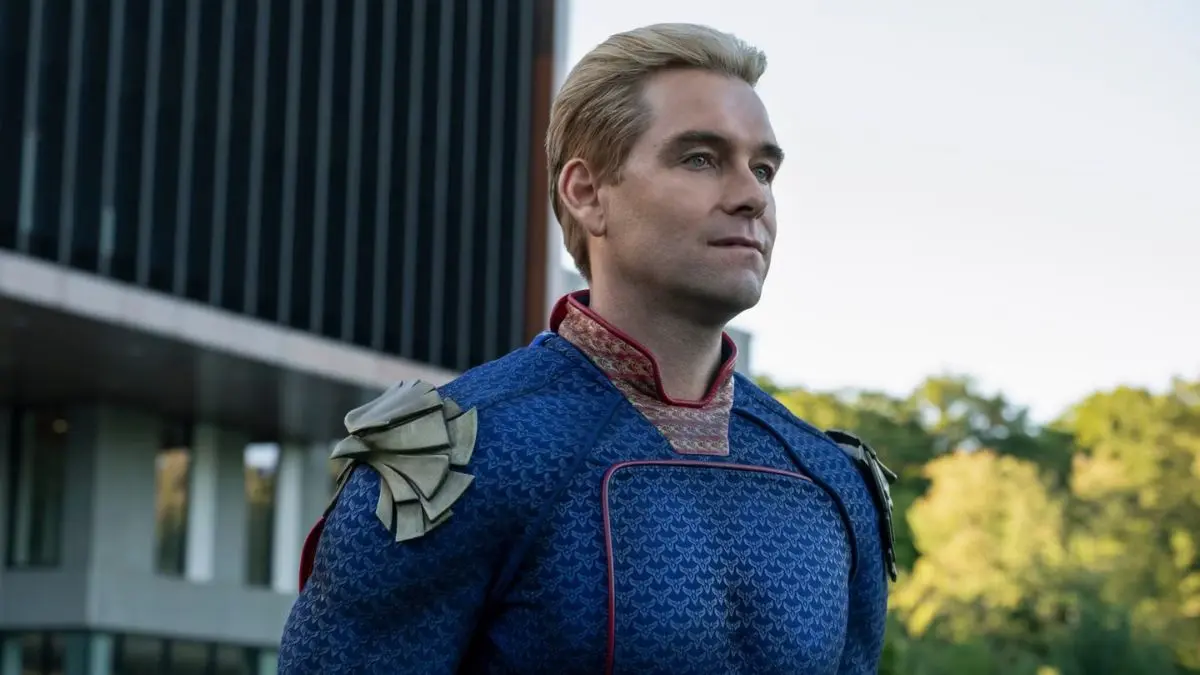
Despite the emotional weight of the storyline, Capone described the atmosphere on set as unexpectedly light during filming. In particular, he recalled moments shared with Antony Starr, who plays Homelander, where the tone between takes shifted dramatically from the intensity of the scene itself. “We were dancing between takes,” Capone said. “Listen, the scene is dark. We had to keep it light.” Between setups, the actors reportedly sang, joked, and deliberately broke tension to manage the psychological demands of the material.
Capone added that Starr would sing Frank Sinatra songs during breaks, while Capone introduced French music in return. The contrast between performance and pause becomes notable in itself: a production built on depicting extreme violence and psychological collapse, sustained in reality by moments of levity and shared rhythm. It highlights the separation between the world on screen and the people constructing it.
One of Frenchie’s final lines becomes the emotional center of the episode. As he speaks to Kimiko, he tells her, “You saved me.” It is a simple sentence, but one that reframes the entirety of their relationship. Capone later described their bond as one built not on resolution, but on acceptance. “The whole arc of Frenchie and Kimiko is finding that one individual that can redeem you, save you and take you in without judgment,” he explained. “It’s just pure love.”
That idea—love as recognition rather than transformation—gives the storyline its emotional clarity. Across seasons defined by violence, moral compromise, and fractured identity, their connection remains one of the few consistent emotional anchors. It does not resolve their trauma, but it allows them to exist alongside it without isolation.
Meanwhile, the broader narrative of The Boys continues to escalate through Homelander’s increasing dominance, as chaos spreads further across the country. His arc moves with a sense of structural inevitability, each step reinforcing a growing collapse of external order. But in contrast to that expanding scale, Frenchie’s storyline moves inward, narrowing toward a single point of emotional meaning.
This contrast becomes one of the episode’s defining structural tensions. Homelander represents expansion without limit, while Frenchie represents connection within limits. One consumes space; the other condenses meaning. And it is within that condensation that the episode finds its emotional center.
The final effect of Episode 7 is not defined by its violence or its narrative consequences, but by its restraint. It does not attempt to reshape the series or redefine its stakes. Instead, it closes one emotional thread with clarity and precision, allowing the character’s journey to end without excess.
What remains is a sense of stillness rather than shock—the recognition that, even in a world defined by chaos, some endings are not designed to reverberate loudly, but to settle quietly, and persist in memory long after the screen goes dark.