Whenever a Beatles lyric from a forgotten B-side starts looping in your head during a movie, it is usually not a promising sign. Yet halfway through Remarkably Bright Creatures, I found myself mentally humming something entirely unrelated to the film’s intended emotional register, as if my brain were politely staging a protest against what was unfolding on screen.
Adapted from the bestselling novel, Remarkably Bright Creatures—hereafter referred to as RBC—arrives with an unusual narrative hook: an octopus named Marcellus who observes human life from the confines of a seaside aquarium in a quiet Washington town.

Voiced by Alfred Molina in a deliberately subdued, almost underwater cadence, Marcellus is not your typical animated protagonist. He spends his days avoiding the intrusive curiosity of schoolchildren and his nights studying the emotional patterns of the humans who orbit his tank.
Chief among them is Tova Sullivan, played by Sally Field, a widowed janitor whose quiet routine masks a life shaped by grief and delayed decisions. She moves through the aquarium with careful precision, her presence as muted as the fluorescent lighting overhead, as if she has been slowly fading into the architecture of the building itself.
The story unfolds in a gentle rhythm: Marcellus observes, Tova cleans, and the town slowly reveals itself through fragments of interaction. A young musician arrives searching for the father he never knew, adding a faint current of narrative urgency that the film seems only partially interested in sustaining.
RBC feels less like a conventional drama and more like a coastal vignette stretched to feature length. It recalls the kind of softly lit British cozy mysteries often found in late-night television reruns, where emotional stakes are suggested rather than declared, and the atmosphere matters more than the plot. The difference is that here, the atmosphere occasionally becomes the entire argument for the film’s existence.
Yet unlike those mysteries, which at least provide a puzzle to solve, RBC offers only the lightest narrative tension. The search for identity undertaken by the musician provides structure, but it never quite develops the momentum expected of a cinematic journey, as if the film itself keeps forgetting it is supposed to be moving forward.
Instead, much of the film’s energy rests on Marcellus’s commentary, which is delivered in a flat, reflective tone that sometimes feels less like insight and more like detachment. His observations are meant to be poetic, though they often land as oddly clinical, as if emotional life is being translated through aquarium glass and never quite reaching the audience intact.
Tova’s world is similarly restrained. Her friendships with fellow retirees are portrayed in gentle, meandering scenes that emphasize companionship over conflict. These moments are intended to be heartwarming, though they occasionally drift into emotional ambiguity, leaving the viewer unsure whether we are witnessing comfort or quiet stagnation.
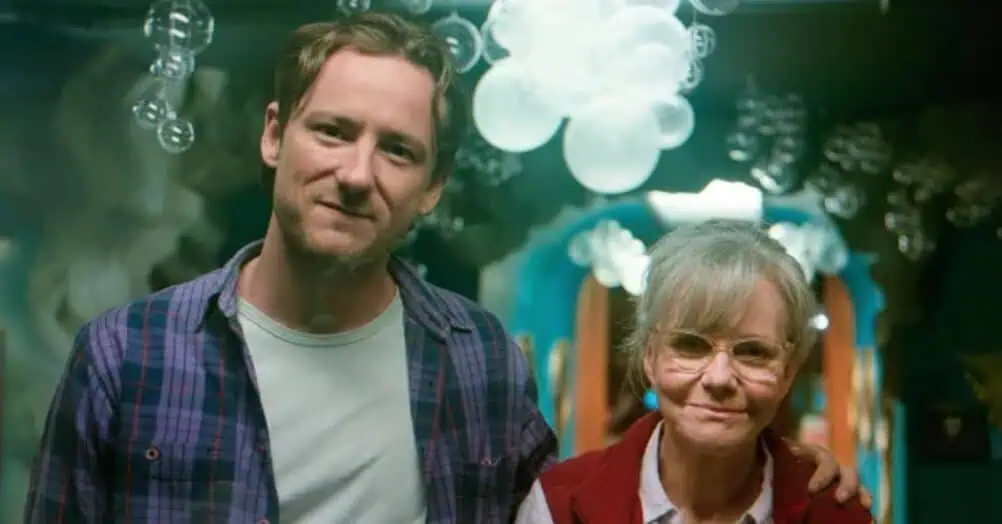
Supporting characters drift in and out of the story with the ease of tidewater. Familiar faces such as Kathy Baker and Joan Chen appear as if summoned from a long tradition of late-career character acting, their presence adding texture but not urgency, like decorative stones placed carefully along a shoreline path.
Colm Meaney appears as a coffee shop owner with a past rooted in music and missed opportunities, offering a subdued romantic possibility for Tova. Their interactions carry warmth, though they rarely escalate beyond polite emotional acknowledgment, as if both characters are waiting for permission to feel something more decisive.
Marcellus, meanwhile, continues to comment on human behavior from his tank, his eight arms a constant reminder of both physical limitation and narrative omniscience. At one point, he notes that Tova “lives in a larger tank than I do,” a line that encapsulates the film’s central metaphor without fully exploring its implications, like a thesis statement that refuses to become an essay.
As the story progresses, the distinction between observer and participant begins to blur, though the film seems uncertain about how deeply it wants to commit to that idea. The result is a tone that hovers between fable and slice-of-life realism, never fully choosing whether it wants to be mystical or mundane.
There are moments where RBC seems to reach for something more profound. A lingering shot of Tova staring at her reflection. A quiet exchange between elderly friends that suggests decades of shared history. A moment where Marcellus presses against the glass as if trying to bridge the gap between species and meaning. But each moment dissolves almost as soon as it forms.
Eventually, the emotional arcs converge at the shoreline, where Marcellus is returned to the sea in a sequence designed to evoke release and reconciliation. It is here that the film most clearly reaches for sentiment, though whether it achieves it depends largely on the viewer’s willingness to meet it halfway across its emotional distance.
There is a sense throughout RBC that it wants to be profound without ever becoming confrontational. Its themes of loss, connection, memory, and rediscovery are gently handled, as if the film is afraid of disturbing its own surface calm, like a pond that reflects beautifully but resists being disturbed.
What remains is a work that is visually pleasant and emotionally restrained, offering comfort rather than challenge. For some viewers, that may be enough. For others, it may feel like watching meaning drift just out of reach, always visible but never fully graspable.

And yet, there is something oddly persistent about it. The image of an octopus quietly watching human grief does linger, even when the narrative itself does not fully commit to its own ideas. Perhaps that is the film’s quiet trick: it stays with you not because it moves you deeply, but because it never quite lets you decide what you are supposed to feel.
In the end, Remarkably Bright Creatures is less about transformation than observation, less about narrative propulsion than atmospheric immersion, and less about resolution than gentle continuation. Whether that is enough to sustain a feature film is a question the audience must answer for themselves long after the credits drift away like tidewater returning to the sea.