Though Apex has sparked plenty of debate among Netflix viewers for its divisive ending and over-the-top survival thriller setup, there’s at least one part of the movie almost everyone seems to agree on: the soundtrack absolutely rules. And out of all the tracks featured in the film, one song has completely taken over social media after playing during the movie’s most tension-filled sequence.
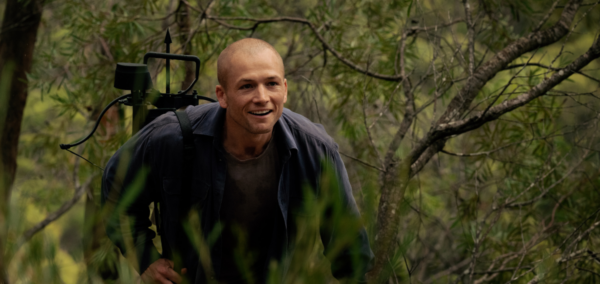
The track in question is “Go” by The Chemical Brothers, and fans have become borderline obsessed with the way the song is used during one of the film’s central hunting scenes. The pulsating electronic track kicks in just as Taron Egerton’s character prepares to begin his terrifying pursuit through the Australian wilderness, instantly transforming the sequence into one of the most memorable moments in the entire movie.
As it turns out, the song’s inclusion almost didn’t happen at all.
Even more interestingly, the decision to use “Go” reportedly came directly from Egerton himself.
Directed by Baltasar Kormákur and starring Egerton alongside Charlize Theron, Apex follows a grieving climber named Sasha who becomes trapped in a brutal survival game after encountering a sadistic hunter deep in the wilderness. The movie leans heavily into psychological tension, physical endurance, and long stretches of nerve-rattling suspense.
Critics haven’t exactly embraced the film wholeheartedly. Reviews have been mixed since the movie dropped on Netflix, with some viewers criticizing the pacing, the logic of the final act, and several character decisions throughout the story. But even many of the film’s detractors have praised its soundtrack and sound design.
The score itself was composed by Icelandic musician Högni Egilsson, who previously collaborated with Kormákur on projects like Katla and King & Conqueror. The film also features an eclectic lineup of licensed songs that swing wildly between genres and moods.
Among the featured tracks are Boogie Street by Leonard Cohen, Revolution by Dennis Brown, Walk by Pantera, and Nasty Boy by Trabant.
That last track accompanies one of the movie’s strangest scenes — Egerton’s now-infamous naked swinging sequence — which Kormákur reportedly considered one of his personal favorite moments in the film.
Still, “Go” is the song audiences can’t stop talking about.
The track plays during a pivotal moment early in the hunt. Egerton’s character gives Sasha a head start before beginning his pursuit, setting the timer through music instead of a simple countdown. The sequence combines the song’s relentless beat with the eerie silence of the wilderness in a way that immediately ramps up tension.
According to Kormákur, the scene originally had no music attached at all.
Speaking with Decider, the director explained that the first version of the scene was much simpler and more traditional. Egerton’s character would merely warn Sasha that he’d begin hunting her after ten minutes had passed.
But eventually, the creative team began experimenting with the idea of using a song as the countdown mechanism instead.

Kormákur explained: “Originally in the script, [the line was] ‘Ten minutes, and I’ll come after you.’ We came up with this idea that he was going to put on a song, and when the song is over [he comes after her].”
Once that concept was established, the team apparently went through multiple possibilities before Egerton suggested “Go.”
The director immediately understood why it worked.
“I didn’t want a disco song or something like that,” Kormákur said. “Taron brought this song by the Chemical Brothers, and I was like, ‘That’s perfect.’”
What makes the choice especially effective is how aggressively the track drives the sequence forward. “Go” isn’t subtle. It’s pounding, repetitive, tense, and almost hypnotic — exactly the kind of music that turns anticipation into anxiety.
The lyrics themselves are minimal, but the energy feels relentless, mirroring the inevitability of the hunt that’s about to begin.
Apparently, though, not everyone working on the movie was convinced at first.
Kormákur admitted there was resistance behind the scenes about using the song, with some collaborators reportedly feeling it didn’t fit the tone of the movie. The concern seems understandable on paper. Apex is often grim, atmospheric, and emotionally heavy, while “Go” has a sharper, more stylized energy.
But the director trusted the instinct anyway.
“Not everyone was of that mind in the beginning,” he explained. “There was a lot of, ‘Oh no, no, no, it’s not the right song.’”
Rather than abandoning the idea immediately, Kormákur pushed ahead with filming the scene using Egerton’s suggestion. His logic was simple: if it didn’t work, they could always replace the music later during editing.
Instead, the opposite happened.
“Then Taron did [the scene] and the whole crew and everyone involved was like, ‘That’s it. It’s perfect,’” the director said.
Honestly, it’s easy to understand why audiences latched onto the moment so quickly.
The scene manages to capture something many thrillers struggle with: genuine momentum. Rather than relying entirely on dialogue or jump scares, the sequence uses rhythm and sound to create dread. The audience knows exactly what’s coming once the song ends, which somehow makes the waiting even worse.
It also helps that Egerton fully commits to the performance. His character’s calm confidence during the setup makes the entire thing feel deeply unsettling, almost playful in a way that becomes increasingly disturbing as the sequence unfolds.
That contrast between style and violence is something Apex leans into repeatedly throughout the film.

In many ways, the use of “Go” reflects the movie’s overall identity. Apex may not always work narratively, but it clearly understands how to create individual moments that stick in viewers’ minds. The soundtrack plays a huge role in that.
Social media reactions have been especially enthusiastic about the scene. TikTok edits using “Go” have exploded since the film’s release, while many viewers admitted they immediately added the track back into their playlists after watching the movie.
Some fans even argued the sequence feels like something straight out of a much more critically acclaimed thriller — the kind of scene people reference years later even if they barely remember the plot surrounding it.
That’s probably the biggest compliment a soundtrack moment can receive.
Because while audiences may continue debating Apex’s ending or criticizing parts of its story logic, the “Go” sequence has already cemented itself as the film’s defining moment. And based on Kormákur’s comments, the movie owes that entirely to Taron Egerton trusting his instincts about one very specific song choice.