Ah yes, House of the Dragon. The Game of Thrones prequel that arrived with the weight of a dynasty behind it has often felt like it was struggling to decide whether it wanted to be an epic of ruthless political storytelling or a sprawling family saga lost in its own time jumps and narrative detours.
After two uneven seasons—one marked by abrupt exits of compelling characters and jarring recasts, the other by a slow build that never quite detonated into payoff—season three arrives with something the series has been accused of lacking: direction.
And, surprisingly, it works.
The opening stretch of the new season feels tighter, more purposeful, and far more confident in what it wants to be. Gone is the sense of narrative drift that previously dulled its momentum. In its place is a sharpened focus on conflict, consequence, and the brutal logic of power.
The result is a premiere that finally feels like Game of Thrones television at its best: large in scale, but precise in execution.
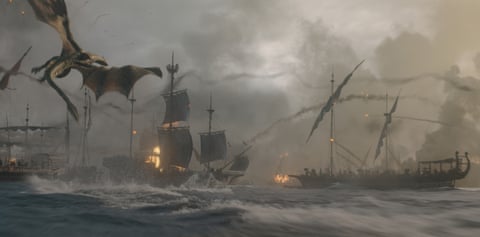
The season wastes no time throwing viewers back into the fractured political landscape of Westeros, where the collapse of unity has created a vacuum that every surviving faction is desperate to fill. The Targaryen civil war continues to escalate, and with it comes the first major turning point of the season: the Battle of the Gullet.
A naval confrontation of staggering scale, the sequence serves as both spectacle and narrative anchor. Vast fleets collide across churning waters while dragons circle overhead like living weapons of mass destruction, reshaping the battlefield with fire and terror.
It is the kind of sequence the show has been building toward since its inception.
Yet what makes it work is not just its scale, but its structure. Beneath the visual chaos, House of the Dragon carefully threads smaller, character-driven conflicts that give the destruction emotional weight.
At the center of the battle is Corlys Velaryon, the seasoned strategist known as the “Sea Snake,” played with controlled gravitas by Steve Toussaint. A man defined by experience and restraint, Corlys approaches the confrontation not as a glory-seeker but as someone constantly balancing duty with personal regret.
Opposing him is Sharako Lohar, played with fierce unpredictability by Abigail Thorn, whose performance injects the battlefield with volatile energy. Lohar is a commander who thrives on chaos, someone who treats fear not as a limitation but as fuel.
Their clash is not just tactical—it is philosophical.
What unfolds is a relentless escalation of violence: arrow volleys tearing through wooden decks, hand-to-hand combat spilling across burning ships, and the ever-present threat of dragons turning the sea into a scorched graveyard.
By the end of the sequence, the question is not simply who wins, but what is left worth claiming after such destruction.
Even now, the series continues to wrestle with one of its central creative tensions: the dragons themselves.
At times, they feel like the ultimate narrative asset—mythic, terrifying, and visually extraordinary. At other moments, they risk overshadowing the human drama that anchors the story. The metaphor is clear enough: nuclear-level power controlled by rulers whose judgment is increasingly fragile.
But the balance is delicate.
When dragons dominate the screen, the human cost can feel distant. When they recede, the political intrigue risks losing its sense of overwhelming stakes. Season three, so far, appears more aware of that tension than previous installments, attempting to integrate both rather than privilege one over the other.
Meanwhile, the aftermath of the Gullet sets in motion a series of shifting alliances and personal reckonings.
Three women, in particular, emerge as central figures in the evolving power struggle, each facing choices that will define not only their futures but the fate of the realm itself.
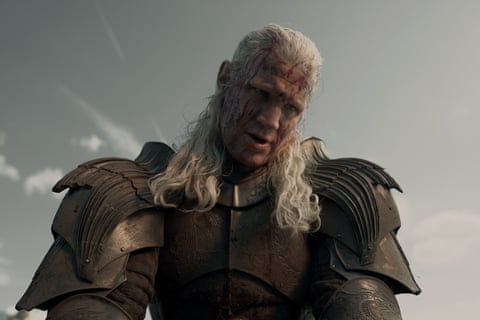
Rhaenyra Targaryen, played by Emma D’Arcy, continues to assert her claim to leadership with a blend of wounded intensity and strategic patience. There is a sense that every decision she makes is shaped by both grief and determination, a combination that fuels her rise but also threatens to consume her.
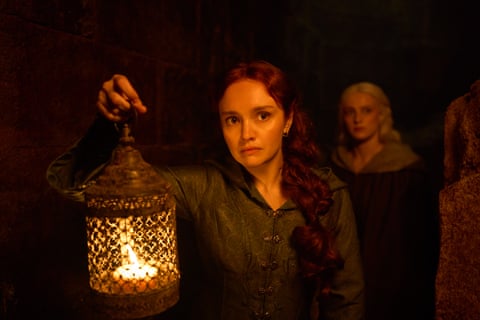
Opposite her stands Alicent Hightower, portrayed by Olivia Cooke, whose presence remains one of the show’s most complex emotional anchors. Neither fully ally nor outright enemy to Rhaenyra, Alicent occupies a liminal space defined by survival, guilt, and shifting loyalties.
Her greatest complication, however, remains within her own family.
Her son, Aemond Targaryen—played with icy precision by Ewan Mitchell—looms over the narrative as both weapon and wildcard. With his signature eye patch and unsettling composure, Aemond represents a generation raised in violence and now fully prepared to perpetuate it.
The interplay between Rhaenyra and Alicent, in particular, has begun to take on a sharper dramatic edge. Both Emma D’Arcy and Olivia Cooke deliver performances that feel increasingly central to the show’s identity, grounding its sprawling political chaos in emotional specificity.
Rhaenyra carries the weight of expectation and loss, while Alicent moves through a world where every alliance feels temporary and every truth feels negotiable.
The result is a dynamic that feels less like rivalry and more like mutual entrapment.
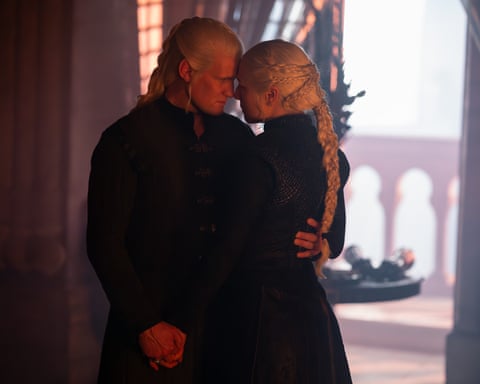
Hovering above much of the political maneuvering is Matt Smith’s Daemon Targaryen, a character who continues to operate as both catalyst and disruption. Whether on the battlefield or in quieter moments of manipulation, Daemon remains a figure defined by contradiction: violent yet strategic, impulsive yet oddly perceptive.
Smith plays him with an almost reckless charisma, a man who understands exactly how dangerous he is and seems to enjoy it anyway.
Many characters continue to underestimate the consequences of engaging him directly. Swords, words, or political schemes—none of them seem to land cleanly.
Yet Daemon is often at his most compelling when the violence pauses. In those quieter moments, the smirk fades just enough to reveal something more unstable underneath, suggesting that even he is not entirely in control of what he has become.
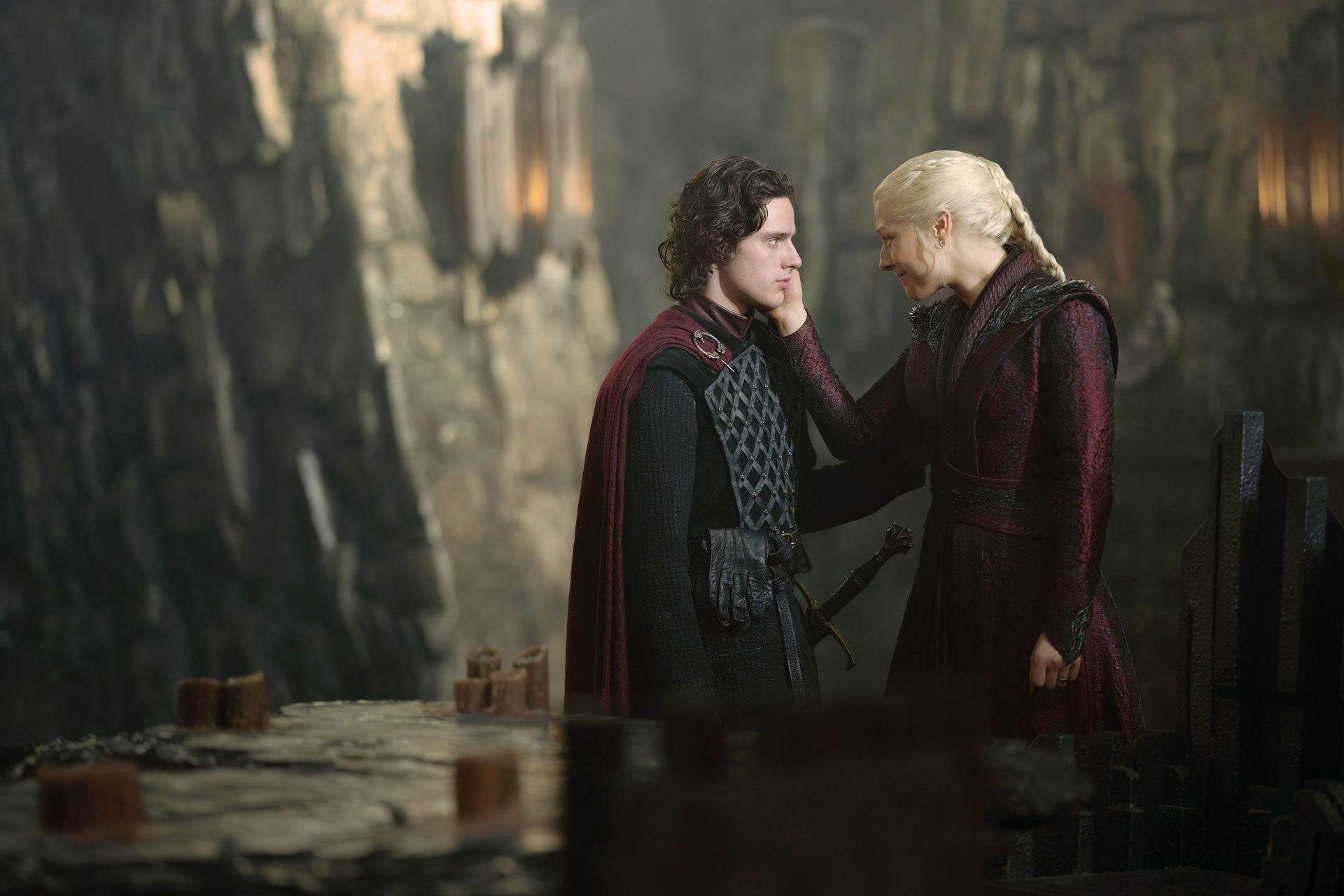
Despite its reputation for grim intensity, House of the Dragon occasionally surprises with moments of levity and unexpected charm. A dragon abandoning its rider only to return later carrying livestock feels almost mischievous in tone, while smaller character beats offer brief relief from the relentless political tension.
Even secondary figures, such as Tom Bennett’s Ulf, inject bursts of dark humor into an otherwise heavy narrative landscape, reminding viewers that absurdity often coexists with catastrophe in Westeros.
Season three also introduces new players sparingly, but effectively. James Norton’s early appearance as Lord Ormund Hightower adds a layer of aristocratic satire to the proceedings, even if his presence is brief. A single exchange involving a disgusted messenger and bureaucratic disdain manages to cut through the show’s otherwise solemn tone with surprising comedic timing.
Then, almost as quickly as he arrives, he disappears back into the larger political machinery of the story—an intentional reminder that in this world, even intriguing figures are often subsumed by larger forces.
What distinguishes this season so far is not that it abandons complexity, but that it finally appears to be organizing it.
Where earlier installments sometimes felt overwhelmed by their own ambition, season three leans into clarity without sacrificing scale. Battles are more legible, character motivations more sharply defined, and thematic through-lines more consistently developed.
Power, inheritance, and consequence remain the core pillars of the narrative—but now they are presented with a greater sense of control.
Whether this momentum can be sustained remains to be seen.
But for the first time since its debut, House of the Dragon feels less like a sprawling prequel trying to justify its existence, and more like a fully realized drama in its own right—one willing to embrace both the grandeur and the brutality that define its world.
And as dragons circle once again over Westeros, it finally feels like the fire is being aimed with purpose.