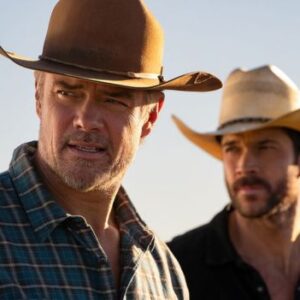
The AMC crime drama Dark Winds arrived in 2022 with many of the familiar ingredients of a traditional police procedural: murder investigations, dangerous criminals, tense interrogations, and officers chasing answers through a world filled with secrets. On the surface, it may appear to follow the same formula as countless other detective shows that dominate television screens in the United States and the United Kingdom.
But beneath that familiar structure lies a story that is far more complex.
What makes Dark Winds stand apart is not simply the crimes being investigated, but the world in which those crimes happen. Instead of focusing on serial killers or elaborate games between detectives and villains, the series explores the realities of law enforcement within Indigenous communities, where solving a case often involves confronting generations of historical trauma, complicated jurisdiction issues, and personal conflicts that cannot be neatly resolved when the final suspect is arrested.
Many police dramas rely on a familiar pattern. A shocking crime occurs, usually connected to a dangerous criminal who leaves behind clues. The investigators follow those clues, slowly uncovering the villain’s identity while the audience watches a psychological battle between the hunter and the hunted.
Eventually, justice is served. The criminal is captured, the truth is revealed, and the officers celebrate their victory.
Dark Winds approaches crime from a very different perspective.
The Navajo Tribal Police officers at the center of the series are not simply outsiders entering a community to solve a mystery. They are part of the community themselves. The victims are their neighbors, relatives, and friends. The crimes they investigate are deeply connected to the social and historical realities of life on the reservation.
That difference changes everything.
In many real-life cases involving Indigenous communities, investigations can become complicated because of overlapping authority between tribal, state, and federal governments. Questions about who has jurisdiction, who has responsibility, and who has the power to prosecute can create significant challenges.
Dark Winds reflects those realities by showing a justice system where answers are not always easy to find and where solving one crime does not necessarily heal the damage left behind.
The victims in the series are not simply characters whose deaths exist to move the plot forward. Their stories are connected to families, traditions, and communities. The violence affects everyone around them, including the officers investigating the cases.
Rather than ending with a simple victory celebration, Dark Winds often focuses on the emotional consequences of violence. The characters are left to deal with grief, guilt, and the lasting impact of the crimes they encounter.
The setting also plays a major role in separating Dark Winds from other crime dramas.
Filmed on and around the Navajo Nation, the series takes place in a landscape defined by breathtaking beauty, isolation, and economic hardship. The vast deserts, mountains, and remote communities create an atmosphere unlike the urban environments often seen in detective shows.
The Navajo Nation itself becomes almost another character in the story.
The series embraces Indigenous culture in a way rarely seen in mainstream television. Many cast members are Diné or members of other Native tribes, bringing personal connections and cultural understanding to their roles.
The Diné language appears throughout the series with English subtitles, while Navajo traditions and healing ceremonies are portrayed as meaningful parts of the characters’ lives rather than simple cultural decoration.
This emphasis on authenticity extends beyond the screen. Productions such as Dark Winds have also created employment opportunities within the region, involving hundreds of local workers during filming.
Another important difference is the way Dark Winds portrays its characters.
Unlike many modern crime dramas where detectives are often defined by trauma, addiction, or self-destructive behavior, the officers in Dark Winds are not simply broken individuals trying to survive their jobs.
Their struggles are more deeply connected to identity, family, and responsibility.
The goal is not only to catch criminals but also to restore balance. For many characters, healing comes through connection with their culture, their families, and traditional Navajo practices.
The influence of author Tony Hillerman is impossible to ignore.
Readers familiar with Hillerman’s mystery novels will recognize the foundation of the series. His stories featuring Joe Leaphorn and Jim Chee introduced millions of readers to crime fiction rooted in Navajo culture and the American Southwest.
Although Hillerman was not Native American, his long relationships with Indigenous communities influenced his writing and helped create some of the most recognizable Indigenous characters in American mystery fiction.
Before Dark Winds, several adaptations of Hillerman’s work struggled to find success. The AMC series changed that by bringing Leaphorn and Chee into a modern television landscape with a larger audience and a stronger commitment to representation.
The show also arrived during a period when Indigenous stories were gaining more attention in Hollywood. Other projects, including Longmire and films featuring performers such as Lily Gladstone, helped expand the visibility of Native experiences on screen.
Dark Winds continues that movement by presenting Indigenous characters as complex, powerful, and fully developed individuals.
Representation is especially important because Navajo culture and many other Indigenous traditions recognize the importance of balance between male and female voices.
The series reflects this through its central characters.
Zahn McClarnon, who is Hunkpapa Lakota and Irish, portrays Joe Leaphorn, one of the show’s primary investigators. His counterpart is Emma Leaphorn, played by Navajo actress Deanna Allison. Emma brings a different perspective as a reservation nurse and as someone deeply connected to the community.
The second major partnership comes through Jim Chee and Bernadette Manuelito.
Kiowa Gordon, known internationally for his role in The Twilight Saga, plays Chee, while Canadian actress Jessica Matten portrays Bernadette. Matten, who has Métis, Saulteaux, and Cree ancestry, brings experience from other Indigenous-focused productions.
Their relationship is not simply romantic. Bernadette is also Chee’s professional rival, creating a dynamic built on respect, conflict, and shared responsibility.
Behind the scenes, Dark Winds has also attracted major names. Executive producers have included George R.R. Martin, Robert Redford, and filmmaker Chris Eyre, who is Cheyenne and Arapaho.
The involvement of such influential creators has helped bring greater attention to the series and its mission of telling Indigenous stories.
The success of Dark Winds raises a larger question: has Hollywood finally begun to approach Native American stories differently?
For many viewers, especially those unfamiliar with Indigenous communities, the series provides an opportunity to see a side of American life that is often overlooked.
The American Southwest is home to some of the richest and most diverse Indigenous cultures in the country, yet those communities are frequently misunderstood or ignored in popular media.
Dark Winds does not attempt to present a perfect or simplified image. Instead, it shows people dealing with ordinary struggles, extraordinary challenges, family conflicts, and the responsibility of protecting their communities.
That realism may be the series’ greatest strength.
The show proves that Indigenous stories do not need to be limited to historical dramas or stereotypes. They can exist within genres like crime thrillers, mysteries, and psychological dramas while still maintaining cultural depth and authenticity.
As Dark Winds continues its journey, there is also room for even more Indigenous representation. Future seasons could potentially bring together actors such as Lily Gladstone or Robert Taylor from Longmire, expanding the show’s already impressive ensemble.
After several seasons of success, Dark Winds has demonstrated that audiences are interested in stories that feel different — stories rooted in specific communities but carrying universal themes of justice, family, identity, and survival.
In a crowded television landscape filled with familiar formulas, the series has carved out its own path.
And that may be exactly why viewers continue to return to the world of Joe Leaphorn, Jim Chee, and the Navajo Tribal Police.