Dutton Ranch may be set in the sweeping fictional world of Rio Paloma, but behind the camera, the Yellowstone universe spin-off is firmly rooted in real Texas soil.
The Paramount+ drama, which follows Beth Dutton (Kelly Reilly) and Rip Wheeler (Cole Hauser) as they attempt to rebuild their lives after leaving Montana, was filmed primarily across North Texas. And while fans might assume the series continues the same rugged Montana backdrop as Yellowstone, the reality is a deliberate and carefully crafted shift in geography, tone, and visual identity.
:max_bytes(150000):strip_icc():focal(666x191:668x193):format(webp)/dutton-ranch-cole-hauser-051426-d9267bb817ed4c26940c892592231350.jpg)
According to director, cinematographer, and executive producer Christina Alexandra Voros, the decision to relocate the production base was both practical and creative. Speaking to TV Insider, she confirmed that although portions of the pilot episode were shot in Montana, particularly before the story’s pivotal fire sequence, the remainder of the series was filmed in Texas.
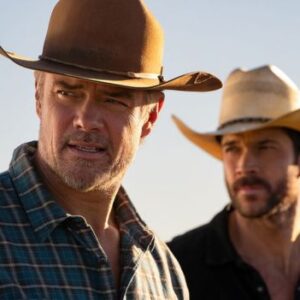
“The light in Texas is so different from the light in Montana,” Voros explained. “There is a harshness to it and a warmth to it. You don’t get the blue mountaintops and the green valleys. It’s a very rich, saturated, hot environment.”
That environmental shift became more than just a backdrop—it shaped the storytelling itself. Voros noted that the production team intentionally leaned into the visual contrast between the two states to reflect Beth and Rip’s emotional transition. Montana represented legacy and loss, while Texas introduced unpredictability, intensity, and a rawness that mirrored the couple’s unstable new beginning.
“We had to navigate how to tell the story in a way that felt familiar in terms of camera language but different in terms of the visual landscape,” she said.
For viewers asking where Dutton Ranch was actually filmed, the answer stretches across multiple North Texas locations. The production centered around Ferris, a small community located roughly 20 miles south of Dallas, with additional filming in Weatherford, Fort Worth, Boyd, Cleburne, Dallas, Rio Vista, and Mineral Wells. Each location was chosen to represent the fictional town of Rio Paloma and its surrounding ranch lands.
:max_bytes(150000):strip_icc():focal(553x193:555x195):format(webp)/dutton-ranch-cole-hauser-051426-58d467ae6edc4d6c93a4bf12e1912c8a.jpg)
Ferris, in particular, became a focal point for production. City officials told the Fort Worth Star-Telegram that they were initially unaware of the full scale of the project when Taylor Sheridan’s King Street Productions first reached out in August 2025. At the time, they knew only that a major television production was scouting the area.
“We absolutely thought it would bring some name recognition, some notoriety to the city,” city manager Brooks Williams said. “We are a town that has been sleepy and small, but we are a town that is absolutely growing, and we have a lot to offer.”
The presence of a major streaming production quickly transformed the area into a hub of activity, with local businesses and residents becoming temporary participants in the expanding Yellowstone universe.
One of the most talked-about sequences in the series—the massive fire that nearly kills Rip and Beth—was also filmed entirely in Texas, despite being set in Montana within the story. Voros confirmed that the production relied heavily on practical effects to capture the intensity of the blaze.
“We did a tremendous amount of the fire work practically,” she said. “The whole sequence with the small calf, most of that was practical fire on location.”
The decision to prioritize real effects over digital enhancements gave the scene a grounded, visceral quality that matched the show’s commitment to realism. It also placed significant physical demands on the cast, particularly Cole Hauser, who performed his own stunts during the sequence.
Hauser told TV Insider that safety and trust with the production team were key factors in his approach to the scene. He even made sure his horse was comfortable with the conditions before committing to the stunt work.
“They let me loose — literally,” he said. “It became this obstacle course of fire and smoke, and I just got after it. It was exciting to do. You see in the show how dangerous it is at times, but it was exactly what I wanted, and Christina filmed it beautifully.”
That emphasis on practical filmmaking extended beyond action sequences. Across the series, Texas landscapes were used to build a distinct visual identity for Dutton Ranch, separating it from its Montana predecessor while still maintaining the franchise’s signature cinematic scale.
Even key ranch locations were carefully chosen to reflect that balance between realism and storytelling. The Edwards Ranch, which plays a central role in the series as the property Rip and Beth take control of, is not fictional in real life. Those scenes were filmed at Saunders Ranch in Weatherford, Texas.
:max_bytes(150000):strip_icc():focal(722x588:724x590):format(webp)/dutton-ranch-kelly-reilly-051426-913e5002780442b881b3110054bc20f0.jpg)
Voros noted that the real-life property carried a sense of history that aligned closely with the show’s themes.
“It very much is in real life what it is in the story,” she said, explaining that the ranch has been owned by the same family for five generations.
The production also used multiple locations to represent different parts of the Edwards and surrounding ranchlands. Some structures were filmed at separate properties to create a composite version of the fictional landscape, blending barns, houses, and open terrain from different sites into one cohesive visual world.
“We used certain locations to cobble together that landscape,” Voros said. “Some of it was the ranch itself, some of it was at another ranch in another location. The barn for the 10 Petal was in a different location than the actual house for the 10 Petal.”
This patchwork approach allowed the creative team to construct a version of Texas that feels both authentic and heightened—an essential requirement for a series that balances grounded ranch life with high-stakes drama.
Despite occasional Montana-set flashbacks and references, the overwhelming majority of Dutton Ranch exists within this carefully curated Texas environment. The shift has also allowed the production to take advantage of Texas’ varied geography, from wide-open plains to dense brushland and industrial outskirts, all of which contribute to the show’s expanding tone.
For fans of the Yellowstone universe, the relocation represents more than a change of scenery. It signals a new chapter for Beth and Rip, one defined not by inherited legacy in Montana, but by survival and reinvention in unfamiliar territory.
And while Rio Paloma may not appear on any real map, the Texas towns that brought it to life are now permanently etched into the expanding footprint of Taylor Sheridan’s television empire.