It’s remarkable how some books seem destined for adaptation from the moment they capture the hearts of readers, and Shelby Van Pelt’s Remarkably Bright Creatures is one of those rare cases. Following the success of the Netflix film based on the 2022 novel, audiences have been drawn once again into the quiet magic of Sowell Bay, this time through the lens of a story that blends grief, small-town quirks, and an octopus whose perspective sees more than we ever imagine.
The film opens with Tova (Sally Field), a 70-year-old widow, navigating her usual late-night cleaning routine at the aquarium. The setting is simple, the lighting soft and reflective, yet every sweep of her mop and every glance toward Marcellus (Alfred Molina) carries a weight of unspoken memory. Tova’s life has been punctuated by loss: her husband, her son, and the small comforts that once gave her day-to-day purpose. Field embodies the quiet dignity of someone who has endured, someone whose life has left its traces in the creases of her hands and the lines on her face. There is a resilience here that isn’t loud; it’s understated, almost imperceptible, but it resonates deeply.

Cameron (Lewis Pullman) enters as a foil and a complement, a 30-something man on the cusp of his own awakening. Having just arrived in Sowell Bay to track down the father he never knew, Cameron’s life is a patchwork of struggles and fleeting dreams. Pullman brings a subtle charm to the role: there’s an edge of vulnerability beneath his confident exterior, a restless energy that contrasts beautifully with Tova’s steady, reflective demeanor. The two are thrown together by circumstance—he is hired to fill in for Tova after she is injured—but their connection grows organically, built on shared grief and mutual curiosity. It is improbable, but convincingly so, and the film leans into that improbability, allowing both characters to find solace in each other’s company.
Director Olivia Newman, who co-wrote the screenplay with John Whittington, ensures that the octopus, Marcellus, remains central without ever being overbearing. The narrative never strays into anthropomorphism beyond its clever storytelling device. Marcellus observes, processes, and narrates in a way that feels intimate and almost conspiratorial. His silent guidance helps both Tova and Cameron navigate their respective traumas, offering audiences moments of reflection and gentle humor without tipping into sentimentality.
The town of Sowell Bay is a character in its own right. Its streets are familiar and comforting, populated by residents who carry their quirks with pride. Colm Meaney’s ex-Deadhead shopkeeper delivers warmth and levity, while Joan Chen, Kathy Baker, and Beth Grant’s portrayals of Tova’s friends offer subtle background textures, a reminder of human connection in small doses. These secondary characters rarely dominate the screen, but they provide context, anchoring Tova and Cameron in a world that is tangible, lived-in, and full of history.

The film’s pacing mirrors the novel’s slow-burn charm. Scenes unfold deliberately: Tova’s meticulous cleaning routines, Cameron’s hesitant interactions with townsfolk, quiet evenings by the aquarium. There is a rhythm here, one that allows viewers to feel the ebb and flow of life in Sowell Bay. Even minor plot points—Tova’s reflections on her late husband, Cameron’s encounters with clues about his father—carry weight because the film never rushes to tie them up neatly. The emotional resonance is earned, built gradually through observation, dialogue, and understated performances.
Where the movie truly shines is in its exploration of grief and connection. Tova’s conversations with Marcellus are interspersed with memories of her son, moments of self-doubt, and the occasional flash of joy. Cameron, meanwhile, is portrayed with the rawness of someone unaccustomed to confrontation, learning how to reconcile his longing for familial connection with the reality of the father he discovers is not quite what he imagined. Field and Pullman balance these arcs with precision; the audience is never led by the hand but gently guided toward understanding, empathy, and eventually, catharsis.
A standout sequence involves Tova and Cameron confronting a long-held secret about her late son. The revelation is delivered not through melodrama but through quiet conversation, subtle gestures, and shared silence. It is a testament to the screenplay’s strength that such moments feel organic. The audience experiences the grief alongside the characters, sensing the relief, the regret, and the tentative hope for new beginnings.

Marcellus punctuates these human moments with observational humor. His narration bridges the gap between Tova and Cameron’s inner worlds and the audience, providing a lens that is both omniscient and intimately personal. Molina’s voice work is precise, capturing the octopus’s wry, knowing tone without turning him into a caricature. It is a delicate balance, and the film manages it with finesse.
Supporting performances, though occasionally underused, add texture. The quirky town residents, Cameron’s sparse interactions with his estranged father, and Tova’s limited but meaningful connections outside the aquarium all contribute to a sense of realism. Newman’s direction ensures that these elements never overshadow the central narrative but instead reinforce the themes of healing, reconciliation, and the quiet courage required to face one’s past.
Visually, the film is striking without being flashy. The Pacific Northwest backdrop—rain-soaked streets, misty harbors, the reflective surfaces of the aquarium tanks—provides an atmospheric richness that complements the story’s emotional depth. Cinematography highlights the contrast between Tova’s structured, controlled life and Cameron’s transient, uncertain journey, underscoring their eventual symbiosis.
By the time the climax arrives, the emotional weight of the story has been fully established. Tova and Cameron confront their losses, their fears, and their need for connection. The resolution, while slightly predictable in terms of plot mechanics, is satisfying because it prioritizes emotional truth over spectacle. The film ends on a note that is both uplifting and contemplative, leaving viewers with the lingering sense that life, with all its complexity, still offers opportunities for growth, understanding, and unexpected friendships.
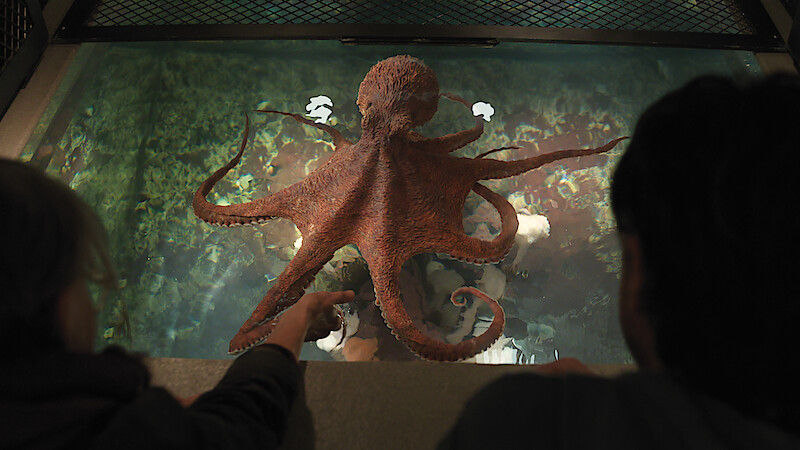
In a media landscape crowded with flashy adaptations and formulaic dramas, Remarkably Bright Creatures stands out for its sincerity. It does not rely on high-stakes action or shocking twists. Instead, it trusts its characters, its story, and its audience, creating a cinematic experience that is gentle, thoughtful, and profoundly human. It is the kind of film that encourages reflection, invites empathy, and ultimately reminds viewers that even in the smallest towns, with the most unlikely companions—including a wise, cranky octopus—life’s remarkable connections are waiting to be discovered.
For fans of the novel, the adaptation is a faithful translation that preserves the heart of Van Pelt’s storytelling. For newcomers, it offers a quietly powerful exploration of grief, friendship, and the ways we communicate with the world around us. With compelling performances from Field, Pullman, and Molina, and the deft hand of Newman’s direction, the film is more than just an adaptation—it is a cinematic reminder of the enduring power of storytelling, the resilience of the human spirit, and the unexpected ways in which life can still surprise and uplift us.