MY HUSBAND SLAPPED ME IN FRONT OF 600 GUESTS AT OUR ANNIVERSARY GALA — THEN I CALLED THE MAN THEY THOUGHT WAS A NOBODY
The first thing I tasted on our fifth wedding anniversary was blood and vintage champagne.
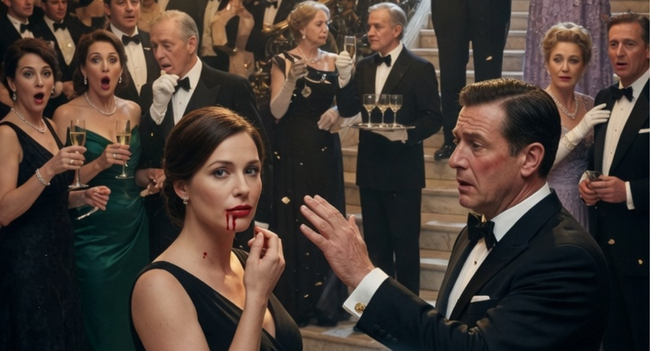
My husband had just slapped me hard enough to split my lip in front of six hundred of Chicago’s most powerful people, and the only thing the Ritz-Carlton ballroom seemed to feel was mild embarrassment. Not for me. For him. For the spectacle. For the slight disruption to an otherwise flawless evening of crystal chandeliers, thousand-dollar wine, and conversations about private equity and summer homes in Lake Geneva.
I did not cry.
That seemed to surprise them more than the slap itself.
I stayed on my knees for one long second on the polished marble, one hand pressed to the stinging side of my face, feeling the warm metallic taste fill my mouth. The string quartet had stopped mid-note. Waiters in white jackets froze with trays balanced perfectly in the air. Women in silk gowns leaned toward one another and whispered behind diamond-heavy fingers. Men in tuxedos frowned the way people frown when the help has spilled something expensive.
Harrison Langford stood over me breathing hard, his chest heaving, his face twisted into the kind of righteous fury men like him call “self-control” once the damage is already done.
“You did this to yourself,” he hissed, low enough that only the nearest tables could hear, but loud enough that everyone would know he was still in charge.
I lifted my head and looked at him.
Five years of swallowing my voice, making myself smaller, softer, quieter, all to preserve a marriage built on illusion, burned away in that single moment. There was no grief left. There was no fear. Only a cold, eerie stillness, like the air right before a storm rips the roof off a house.
I wiped my mouth with the back of my hand, tasted blood again, and rose slowly to my feet.
Then I reached into my evening clutch, took out my phone, and called the only man in Chicago who had ever loved me enough to let me make my own mistakes.
He answered on the first ring.

“Dad,” I said, my voice so calm it startled even me, “come get me. Pull the net.”
There was a pause no longer than a breath.
Then my father said, “I’m on my way.”
I ended the call and slipped the phone back into my bag.
Across from me, Harrison laughed. It was a brittle, performative laugh, the kind he used in boardrooms when he wanted everyone to know he was still in control.
“Did you hear that?” he called to the room, turning slightly so the investors, politicians, developers, and socialites could all enjoy the joke. “She called her daddy.”
Scattered laughter answered him.
“What’s he going to do?” Harrison continued, grinning now. “Drive his rusted pickup to the front of the Ritz? Offer to change my oil in the valet lane?”
More laughter. Cruel this time. Comfortable.
I stared at him and said nothing.
He mistook silence for weakness. That was the mistake every one of them had always made.
An hour earlier I had been seated at the head table in a simple black gown so understated it was practically an insult in a room like this. Harrison had hated it the moment he saw me in our bedroom.
“You couldn’t even try for one night?” he had asked while adjusting his cuff links. “You always make it look like I married my accountant.”
I had almost laughed at how accurate that was, considering I had spent the last three years quietly fixing his family’s financial disasters under a pseudonym.
Instead I had only said, “It’s a dinner, Harrison, not a coronation.”
He had smiled at me in the mirror. It was not a warm smile. “Everything is a coronation when my father is involved.”
That was true.

Winston Langford had built his life around being witnessed. He was one of those men who believed money was not just freedom but proof of moral superiority. He had made his first fortune in commercial real estate when Chicago was changing faster than its people could keep up. He bought blocks, moved tenants out, built glass towers, smiled for magazines, funded museum wings, and convinced himself that because he could put his name on buildings he had also earned the right to decide what kinds of people belonged inside them.
From the moment Harrison brought me home, Winston had decided I did not belong.
I still remembered that first dinner in their Gold Coast penthouse. The apartment looked like a catalog for old-money insecurity — oil paintings, bronze horses, carpets too rare to step on. Caroline, Harrison’s mother, had inspected me as if I were a used handbag. Harrison had held my hand too loosely, already embarrassed. And Winston, seated at the head of that endless table, had spent most of the evening asking me questions that were not really questions at all.
Where did I grow up?
What did my father do with his hands all day?
Did I understand what kind of social obligations came with marrying into a family like theirs?
At the end of the meal, my father arrived to help me carry down a box of childhood things Harrison had insisted I bring over that night. Dad had driven in from his small house in the western suburbs in an old Ford truck because he refused to hire a car when his own vehicle worked just fine. He wore faded jeans, work boots, and a flannel shirt stained with grease from repairing the truck’s alternator that afternoon.
He had smiled at Winston and offered his hand.
Winston shook it with two fingers.
That was all it took.
He never looked any further than the flannel.
He never wondered why the watch under my father’s cuff cost more than his own car, because the man wearing it did not look like the kind of person Winston considered important. He never ran a background check. He was too arrogant to think he needed to.
By the time Harrison and I got married, Winston had convinced himself he was protecting the family line from contamination. He summoned me to his office one afternoon, set a brutal prenuptial agreement on his desk, and told me in a voice as smooth as polished stone that if I did not sign it, there would be no wedding and Harrison would lose everything.
“I am not punishing you, Stella,” he had said, steepling his fingers. “I am preserving order.”
I had read every clause.
No spousal support. No claim to premarital assets. Total separation of property.
I signed.
Winston thought he was fencing me out of their money.
In reality, he was building a fortress around mine.
Because the truth was almost offensively simple: I was not poor. I had never been poor. My late mother had been the only child of a logistics magnate whose empire stretched from shipping corridors to freight terminals across three continents. When she died, everything passed to me through a trust designed by people far more ruthless and more intelligent than Winston. By the time I turned thirty-three, the family holdings under that structure—managed, shielded, and expanded—were worth well over two billion dollars.
My father, Alexander Whitaker, controlled the broader private equity firm that handled much of it. He could have filled magazines with his face if he wanted. He could have hosted fundraisers and collected awards. But after my mother died, he wanted no part of high society. He bought land, retreated from spectacle, rebuilt vintage engines with his own hands, and ran one of the most feared investment firms on Wall Street from behind a veil so thick most people only knew his name, not his habits.
He used to say there were two kinds of rich men in Chicago: those who wanted to be seen and those who wanted to own the building people mistook for the horizon.
Winston belonged to the first kind.
My father belonged to the second.
And I, in one of the more foolish acts of my life, had wanted to know whether a man could love me without the gravity of my money bending every choice around us. So I told Harrison a partial truth instead of the whole one. I let him believe I carried student debt. I let him believe my father was a mechanic because, technically, he often was. I let him see me as ordinary because I wanted to know if love could exist without calculation.
The answer had been clear much earlier than I wanted to admit.
At first Harrison was merely condescending. He corrected the way I ordered wine. He laughed at the used sedan I drove. He told stories at parties about how “refreshing” it was to be with someone “uncomplicated.”
Then came Winston’s contempt, Caroline’s constant little smirks, the dinners where I was addressed only when my background could be mocked.
And all the while, hidden in plain sight, I was the person keeping their empire from collapsing.
Three years into the marriage, Harrison’s company hired a senior financial risk analyst under strict confidentiality to review a cluster of liabilities that had started alarming even their accountants. The analyst’s reports came in under initials and a third-party billing structure. Winston loved the work so much he began demanding that this invisible genius handle every sensitive problem they had.
What Winston never knew was that I was the analyst.
I spent nights in a locked office untangling commercial zoning violations, debt exposure, forged filings, hidden operating losses, and tax discrepancies that could have triggered investigations years earlier. Their ledgers were a swamp. Harrison’s so-called visionary developments were bleeding cash into empty lots and shell entities. Caroline was using company resources like a personal luxury slush fund. Winston hid losses through offshore structures crude enough to terrify any real auditor.
I should have walked away the first time I saw the scale of it.
Instead, I kept cleaning because I was still stupid enough to think I was preserving my marriage.
By the time of our fifth anniversary gala, I knew exactly how rotten the foundation was. I also knew Harrison had started sleeping with his executive assistant, Vanessa, because men like Harrison always became sloppier as they became more arrogant. He hid perfume badly. He texted like an amateur. And the corporate expense patterns told their own story.
I said nothing.
I kept notes.
I made copies.
I built files.
My father had warned me months earlier that the company was approaching a cliff no internal maneuver could widen into a bridge. He told me I needed an exit plan. We built one together, cautiously.
“Pull the net,” had been our code from when I was a girl. We used to fish at dawn in the summers after my mother died. Sometimes we’d wait in absolute silence, watching the line, until the right moment came.
At the gala, the room glittered with money and old vanity. Investors who had ruined neighborhoods stood shoulder to shoulder with politicians who claimed to protect them. The women wore gemstones like declarations of war. The men wore wealth so carefully curated it became a dialect.
I sat beside Harrison at the head table and barely existed to him.
He spent most of dinner laughing too hard at Caroline’s insults. Caroline wore a diamond necklace I knew had been purchased with misallocated company funds diverted from an employee benefits account.
Then Winston stood.
The room quieted immediately.
He thanked the crowd for their loyalty. He boasted about the company’s thirty-year legacy. He praised Harrison for his leadership. Then he turned toward me, and that little pulse in my throat that always began when he chose me as the evening’s sacrifice started to beat.
“Tonight,” he said, “we also celebrate my son’s generosity.”
Soft laughter. Anticipation.
“Five years ago, Harrison did something I confess surprised even me. He opened his heart. He married for love instead of strategy.”
More laughter.
“He married Stella,” Winston continued, smiling directly at me, “a girl with mountains of student loans and a father who spends his days, I’m told, under old trucks with oil up to his elbows.”
The ballroom chuckled on cue.
“Harrison brought her into our world. He gave her comfort, security, access, a life she could never have imagined. So tonight, as we celebrate our family and our company, let us also celebrate the tremendous charity my son performed for the less fortunate.”
People laughed. Actually laughed.
I heard Caroline’s bright little cackle. I saw Harrison smile down at his plate and then out at the room, pleased with himself.
I looked around and saw six hundred faces enjoying my humiliation because wealth had taught them cruelty was wit if it flowed downward.
Something inside me went still.
I stood up.
The room quieted again, curious now.
I walked around the table until I stood directly in front of Winston.
Then I spoke, loud enough for every table to hear.
“You’re right, Winston. My father does work with his hands. He also happens to own the single largest private logistics and freight empire in the Midwest. He built it from one truck after my mother died. He never needed your approval, your buildings, or your name on anything. And he certainly never needed to humiliate anyone to feel important.”
The silence that followed was absolute.
I turned to Harrison.
“And you,” I said, voice steady, “have been sleeping with your assistant for fourteen months. I have the messages, the hotel receipts, and the corporate credit-card statements. I also have every single document showing how you and your father have been moving money through shell companies to avoid taxes for the last six years. I’ve been the one quietly fixing those books so the IRS didn’t shut you down. I’m done fixing them now.”
Harrison’s face went white.
I wiped the blood from my lip one last time.
Then I looked straight at the entire ballroom and said, “Enjoy the rest of your evening.”
I turned and walked out.
My father was already waiting at the valet stand when I reached the lobby. He wore the same faded flannel shirt and work boots he had worn the first time he met Winston. He didn’t say a word. He just opened the passenger door of his old Ford truck and helped me inside.
As we pulled away from the Ritz-Carlton, I looked back once.
Winston, Caroline, and Harrison were standing at the top of the grand staircase, watching the truck disappear into the Chicago night.
They finally looked small.
Two weeks later the federal investigation began. My grandfather’s old ledger — the one my father had kept for years — provided the foundation for everything. Winston was indicted on multiple counts of tax fraud and wire fraud. Harrison was removed as CEO. The company stock plummeted. Caroline lost her position on three museum boards.
I kept the house in Lincoln Park that my father had quietly purchased in my name years earlier. I kept the life I had built for myself and the daughter I was about to bring into the world.
I never saw Harrison again except in court.
Some families are built on blood.
Others are built on lies.
And sometimes the strongest thing you can do is walk away from the ones who only ever saw you as a charity case — and keep the ones who saw you as a legacy worth protecting.