The Day I Surprised My Wife at Her Office – The Hidden Room Behind Her Bookshelf Held My Missing Daughter
My name is Marcus Reed. I’m forty-two years old, a high school English teacher in Boston, and for the last eight weeks I had been living in a nightmare that had no ending. Our daughter, Abigail—Abby to everyone who loved her—had vanished on a warm September evening while walking home from ballet class. Nine years old, freckles across her nose, always humming show tunes under her breath. One blurry security-camera still from the corner of Beacon Street was all the police had. No ransom note. No witnesses. No body. Just silence.
My wife, Dr. Elena Reed, handled the grief the way she handled everything: with perfect control. She was a prominent family psychologist with a thriving private practice in a restored brownstone on Marlborough Street. Clients paid her four hundred dollars an hour to help them fix their broken families while ours quietly disintegrated. She returned to seeing patients two days after Abby disappeared. “Structure keeps me sane,” she told me the night she made the decision. I took a leave of absence from school and spent my days refreshing missing-person websites and driving the same route Abby had walked, over and over, until the streets blurred.
Today was supposed to be different. I had picked up Elena’s favorite lunch—turkey avocado on sourdough, extra pickles, and a double espresso—because it was our thirteenth wedding anniversary. Thirteen. The number felt like a bad joke now. I told myself that showing up unannounced might remind her I was still here, still fighting for us.
Elena’s assistant, Rachel, greeted me in the quiet waiting room with the sympathetic half-smile everyone gave me these days. “She’s finishing with a client, but she said you can wait in her office. She’ll be thrilled.”
I thanked her and walked down the narrow hallway lined with framed degrees and soothing abstract art. Elena’s office was at the end—double doors, frosted glass, her name etched in elegant gold lettering. I let myself in.
The room smelled of bergamot and expensive leather. Late-afternoon light slanted through tall windows overlooking the Public Garden. Her desk was immaculate: laptop closed, notebook aligned with the edge, a single white orchid in a crystal vase. I set the lunch bag down and sank into the visitor chair, then stood again, restless. My eyes wandered across the built-in bookshelves that covered the entire back wall—hundreds of psychology texts, design books, and a few carefully placed personal touches.
That was when I saw the fountain pen.
It rested on a small silver tray beside her keyboard. Sleek black lacquer with sterling silver trim. Elegant. Expensive. The kind of pen people buy as a once-in-a-lifetime gift. I wouldn’t have given it a second glance if not for the engraving on the barrel, catching the light as I stepped closer.
Abigail Reed – My everything.
My stomach dropped so fast I felt dizzy. I picked the pen up. The metal was cool and heavy. Abby had never owned anything like this. She was nine. She wrote with glitter gel pens and broken crayons. Why would Elena have a four-hundred-dollar fountain pen engraved with our missing daughter’s full name?
My thumb moved over the silver clip almost on its own. Something inside the barrel clicked—a tiny, precise mechanical sound.
Across the room, behind the bookshelves, I heard a soft hydraulic hiss.
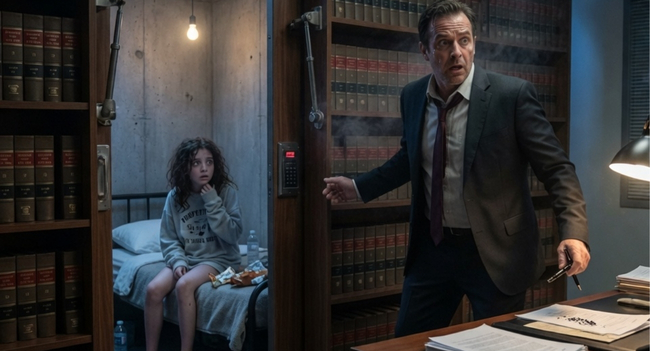
Then the entire middle section of the shelving unit—four feet wide, floor to ceiling—slid silently to the left like a theater curtain.
I stood frozen, the pen still in my hand.

Beyond the opening was a narrow, windowless room no wider than a walk-in closet. Recessed LED lights glowed softly from the ceiling. A twin bed took up most of the space. On that bed, knees drawn to her chest, sat my daughter.
Abby.
She was thinner than I remembered—cheeks hollow, eyes huge and shadowed with exhaustion. Her ballet leotard from the day she disappeared was gone; she wore a plain gray sweatshirt two sizes too big and leggings that hung loose on her legs. Her hair, once a wild mass of dark curls, was matted and dull. A thin silver chain was locked around her ankle, the other end bolted to the metal bed frame.
She looked straight at me and her lips moved, but no sound came out at first. Then, in a voice so small it barely carried across the room:
“Daddy…?”
The pen slipped from my fingers and clattered on the hardwood floor.
I crossed the office in three strides and dropped to my knees at the threshold of the hidden room. Abby scrambled off the bed as far as the chain allowed and threw herself into my arms. She was shaking so hard I could feel her bones through the sweatshirt.
“I knew you’d come,” she whispered against my neck. “Mom said you wouldn’t, but I knew.”
I held her tighter than I had ever held anything in my life. She smelled like hospital soap and fear. Over her shoulder I saw the room in horrific detail: a small shelf with three books (all hers), a plastic pitcher of water, a bucket in the corner with a lid, a single blanket folded at the foot of the bed. No windows. No clock. Just four white walls and the low hum of a ventilation fan.
I pulled back, cupping her face. “Are you hurt? Did she—did Mom hurt you?”
Abby shook her head, tears cutting clean tracks down her dirty cheeks. “She said it was for my own good. She said the world outside was too dangerous. She said if I was good she’d let me out when I turned ten.” Her voice cracked. “Daddy, I’ve been here the whole time.”
Rage and horror collided inside my chest so violently I had to fight not to vomit. Elena—my wife, the woman who once cried watching Abby take her first steps—had kidnapped our own daughter and kept her in a secret room inside her own office for fifty-eight days.
I fumbled for my phone. My hands were shaking so badly I dropped it twice before I managed to dial 911.
“Boston Police,” I rasped the moment the operator answered. “I need officers and an ambulance at 142 Marlborough Street, sixth floor. My daughter Abigail Reed has been found. She’s been held captive—by her mother.”
I gave them the address again, voice breaking. The operator kept me on the line, calm and professional, while I held Abby and rocked her like she was still a baby. She clung to me with surprising strength, whispering the same sentence over and over: “Don’t leave me here. Don’t leave me here.”
Ten minutes later I heard sirens. Footsteps thundered down the hallway. Rachel the assistant appeared in the doorway, eyes wide with confusion, then horror when she saw the open bookshelf and the child inside.
“Oh my God,” she breathed.
I didn’t have time to explain. Two uniformed officers burst in, guns drawn, followed by a plainclothes detective and two paramedics. They took one look at Abby’s chained ankle and the hidden room and their expressions hardened into something cold and professional.
One officer gently pried me away so the paramedics could check Abby. The other started photographing everything. The detective—Detective Morales—knelt beside me while I sat on the floor, back against Elena’s desk, head in my hands.
“Mr. Reed,” he said quietly, “can you tell me what happened here?”
I told him everything. The lunch bag still sitting untouched on the desk. The fountain pen. The click. The wall sliding open. The sight of my daughter on that bed. When I finished, Morales looked at the open room and shook his head once, like he’d seen a lot of evil but this one still surprised him.
“We’ll need that pen for evidence,” he said.
I handed it over without looking at it.
They cut the chain off Abby’s ankle with bolt cutters. She cried out in relief when it fell away. The paramedics wrapped her in a blanket and carried her out on a stretcher even though she insisted she could walk. I followed, holding her hand the entire way down the elevator and into the ambulance.
Elena arrived twenty minutes later.
She stepped out of the elevator in her tailored navy suit, designer heels clicking on the marble floor, looking every inch the successful professional. Two detectives were waiting for her. The moment she saw the open bookshelf and the empty hidden room, her perfect composure cracked.
She didn’t scream. She didn’t run. She simply stood there, face draining of color, and whispered, “How did you find her?”
I stepped forward before the officers could stop me. My voice was raw. “Because I still love you enough to try to surprise you on our anniversary. Because I still believed we were in this together.”
Elena looked at me then—really looked—and for the first time in months I saw the woman I had married. The one who used to dance with Abby in the kitchen. The one who cried at Pixar movies. That woman was gone in the next breath, replaced by someone cold and clinical.
“She was safer with me,” Elena said, voice flat. “The world is dangerous, Marcus. You have no idea what I protect her from every single day. The threats I see in my practice—the predators, the accidents, the broken homes. I couldn’t let that happen to Abby. So I made sure it wouldn’t.”
A detective read her her rights. Handcuffs clicked around her wrists. She didn’t resist. As they led her past me she paused, just for a second.
“Tell Abby I love her,” she said. “Tell her Mommy did this because she loves her more than anything.”
I didn’t answer. I couldn’t.
The next forty-eight hours were a blur of hospitals, police stations, and media trucks parked outside our house. Abby was severely malnourished and dehydrated but otherwise physically unharmed. The psychological damage would take years. She slept in my bed that first night, clinging to me like she was afraid the hidden room would swallow her again if she let go.
Elena was charged with kidnapping, false imprisonment, child endangerment, and a dozen other counts. Her lawyers were already talking about diminished capacity and mental health. The tabloids called it “The Psychologist’s Secret Prison.” Clients canceled appointments in droves. The brownstone was seized as a crime scene.
I quit my job. I couldn’t stand in front of a classroom and talk about hope and resilience when my own life had become a cautionary tale. Instead I spent every hour with Abby—therapy, park walks, late-night talks where she told me what the hidden room had been like. How Elena had visited every evening, bringing meals and books, promising it was temporary. How Abby had learned to stay quiet when clients were in the outer office.
Three months later, on a cold January morning, I sat with Abby on our living-room couch watching snow fall over the Charles River. She was gaining weight again. Her curls were growing back. She still woke up screaming some nights, but the screams were getting shorter.
“Daddy,” she asked quietly, “do you think Mom will ever get better?”
I pulled her close. “I don’t know, sweetheart. But we’re going to be okay. You and me. That’s what matters now.”
She nodded against my chest. Then she reached into her pocket and pulled out something small and silver—the fountain pen, which the police had returned to me after processing. She had asked to keep it.
“I don’t want to be afraid of pens anymore,” she said.
I smiled for the first time in months. “Then we’ll keep it. But we’re going to make new memories with it. Good ones.”
Outside, the snow kept falling, soft and silent, covering the city like a fresh page. Somewhere in a county jail, Elena was probably sitting in a cell writing notes in that same perfect handwriting, still convinced she had done the right thing.
But in our living room, with my daughter breathing steady against my heart, I finally understood something Elena never would: love isn’t control. Love isn’t hiding someone away from the world. Love is letting them walk home from ballet class and trusting they’ll come back to you.
Some days I still wake up reaching for the wife I thought I knew. Some days the anger is so sharp it steals my breath. But every single morning I look at Abby—laughing, drawing, arguing about what to have for breakfast—and I remember the moment that hidden wall slid open and I saw my daughter again.
That moment saved us both.
And no secret room, no perfect professional façade, no amount of clinical reasoning will ever take her away from me again.