The morning air was sharp with pine and frost as four elite military working dog handlers stood outside the reinforced kennel block, their breath fogging in the cold. They weren’t laughing anymore. The nervous jokes from the night before had died somewhere between the third cup of coffee and the fourth set of fresh bite bandages.
Inside the last enclosure, a ninety-pound Belgian Malinois named Titan paced in tight, relentless circles. His coat was sleek black and tan, his muscles carved from years of combat deployments, but his eyes — once bright with purpose — now burned with something darker. Fear. Rage. Grief.
In the last eleven weeks, Titan had sent four experienced handlers to the emergency room. Two with puncture wounds to the forearm, one with a torn bicep, and the most recent — Sergeant First Class Marcus Reilly — with a shattered wrist and a shredded tactical sleeve. The official report called him “unpredictable, aggressive, and a clear danger to personnel.”
The euthanasia order had already been signed. It sat on Major Harlan Brooks’ desk in a plain manila folder, scheduled for 0900 Friday — three days from now.
Major Brooks stood outside the kennel with his arms crossed, jaw tight. “We’ve tried everything,” he said quietly to the small group. “Positive reinforcement, desensitization, even a civilian behaviorist from Denver. Nothing works. He’s not just broken — he’s dangerous.”
No one argued.
Then the crunch of tires on gravel broke the silence.
A dusty, dark-green pickup truck rolled to a stop at the gate. The driver killed the engine and sat for a long moment, staring straight ahead. When the door finally opened, a woman stepped out.
Staff Sergeant Maya Ellison, retired. Thirty-three years old. Five-foot-six, lean and quiet, with dark hair pulled into a tight bun and a faded scar running along the left side of her jaw that she never bothered to hide. Her uniform was crisp but old — the kind of uniform that had seen sand, blood, and too many goodbyes.
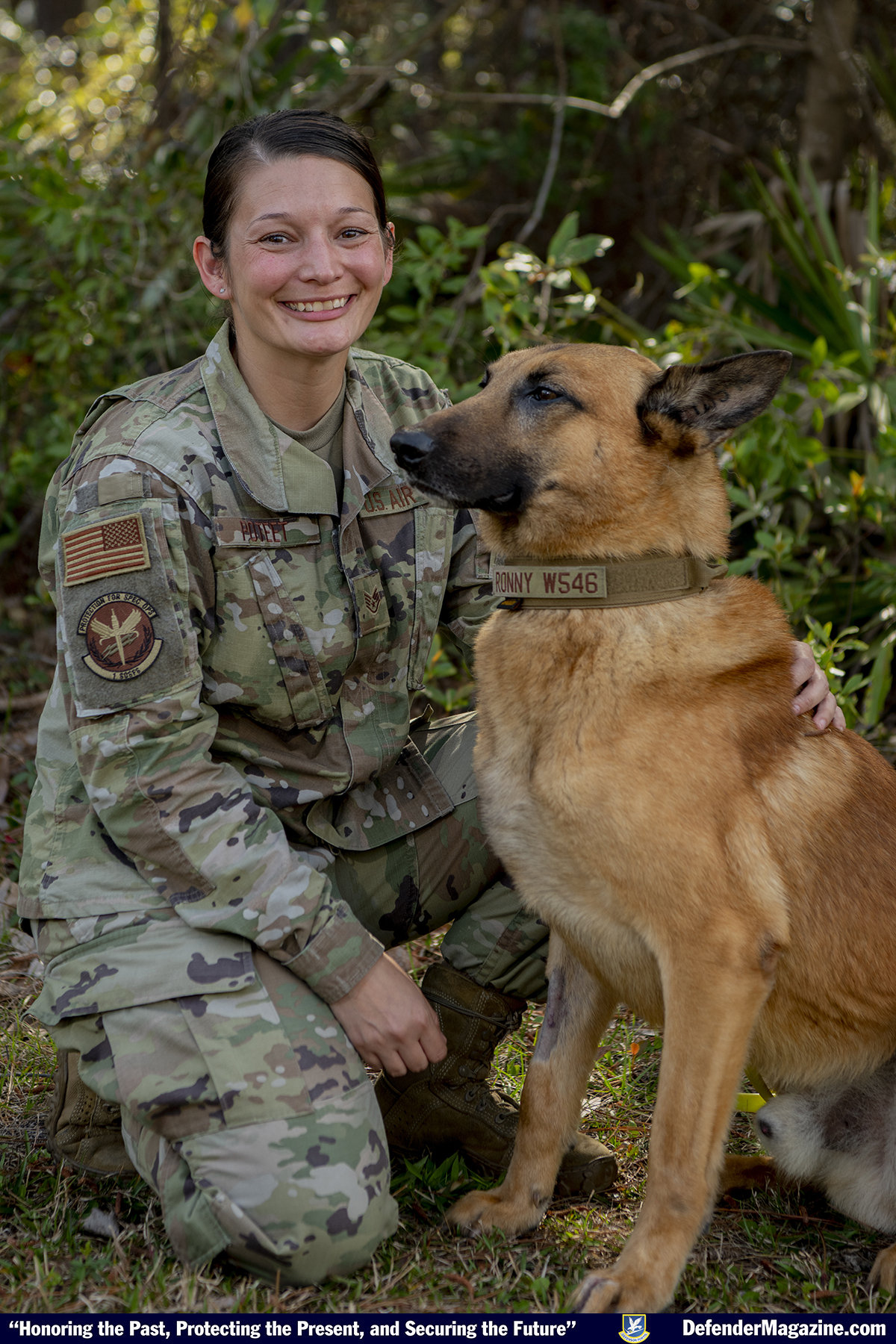
![DVIDS - Images - All Paws On Deck [Image 11 of 11]](https://d1ldvf68ux039x.cloudfront.net/thumbs/photos/2308/7984137/1000w_q95.jpg)
She carried nothing but a small black duffel and the quiet confidence of someone who had already walked through hell and learned how to speak its language.
Major Brooks met her at the gate. “Sergeant Ellison. I wasn’t expecting you until 0800.”
“I drove through the night,” she said simply. Her voice was low, steady, and carried the faint trace of a Texas accent. “I didn’t want to waste any time.”
Brooks studied her for a beat. “You understand this is likely a waste of your time too. Titan has been deemed unsalvageable. The paperwork is done.”
Maya’s eyes flicked toward the kennel block where the big Malinois had gone completely still, ears locked forward, staring directly at her through the chain link.
“I read the file,” she said. “I still want to see him.”
The handlers exchanged uneasy glances. One of them — a young sergeant named Ramirez — muttered under his breath, “Lady, that dog will take your arm off before you even get close.”
Maya didn’t answer. She simply walked past them, boots crunching on the gravel, moving with the calm, deliberate pace of someone who refused to broadcast fear.
When she reached the final enclosure, Titan was already at the gate.
He wasn’t barking.
He was vibrating.
Every muscle in his body was locked, teeth slightly bared, a low growl rolling from deep in his chest like distant thunder. The kind of sound that made grown men step back.
Maya stopped three feet from the gate. She didn’t crouch. She didn’t speak. She simply turned her body slightly sideways — reducing her profile — and let the dog see her fully. Then, in a voice so soft it barely carried past the first row of kennels, she gave a command no one else in the unit had ever heard.
“Echo… shadow.”
The growl stopped mid-breath.
Titan’s ears snapped forward. His head tilted. For three full seconds the entire kennel block went dead silent.
Then the big dog dropped into a sit so fast his hindquarters hit the concrete with an audible thud. His tail gave one slow, uncertain wag.
The handlers behind Maya froze.
Major Brooks’ mouth actually fell open.
Maya took one slow step closer. “Echo… shadow,” she repeated, softer this time.
Titan whined — a small, broken sound — and pressed his face against the chain link, eyes locked on hers like a lost child who had finally found home.
Maya reached through the gate and rested her palm against the dog’s cheek. Titan closed his eyes and leaned into her touch.
No one spoke.
After a long moment, Maya turned to Major Brooks, her voice steady but thick with emotion.
“His real name isn’t Titan,” she said. “It’s Echo. And he wasn’t aggressive. He was waiting.”
She took a slow breath.
“Echo was my partner for two deployments in Afghanistan. We worked together for thirty-one months. Staff Sergeant Lucas Kane was his official handler on paper, but Echo only ever truly listened to me. Lucas was killed in a night raid outside Kandahar. Echo was with him. He watched Lucas die trying to drag him to safety. They pulled Echo out alive, but the dog never came back the same.”
She looked down at the Malinois, who was now completely calm, leaning against her hand like he was afraid she would disappear.
“They reassigned him, changed his name, tried to force new handlers. They treated the symptoms instead of the trauma. He wasn’t being aggressive — he was screaming for the only person he still trusted.”
Major Brooks stared at her. “How did Command even know to call you?”
Maya gave a small, tired smile. “Because I never stopped checking on him. I called every three months for two years. They finally listened.”
She looked back at Echo.
“I’m here now, buddy,” she whispered. “I’m not leaving you again.”
The next seventy-two hours were a blur of paperwork, medical evaluations, and quiet miracles.
Echo — now officially renamed back to his original call sign — was cleared for continued service under Maya’s exclusive handling. The euthanasia order was torn up. The handlers who had once feared him now watched in stunned silence as the same dog who had sent four of them to the ER followed Maya like a shadow, calm, focused, and completely at peace.
On the fourth day, Maya sat on the grass outside the kennel block with Echo’s head resting in her lap. The big dog was snoring softly, ears twitching in his sleep.
Major Brooks walked over and sat beside her.
“You saved him,” he said quietly.
Maya shook her head. “No. I just reminded him he wasn’t alone.”
She ran her fingers through Echo’s fur, tracing the old scars from shrapnel and rough training.
“These dogs give everything,” she said. “They go where we send them, they bleed for us, they mourn when we die. The least we can do is remember their names.”
Brooks nodded slowly. For the first time in weeks, the weight on his shoulders seemed a little lighter.
Two months later, Maya and Echo were officially reactivated as a specialized search-and-rescue team. Their first mission was a training exercise in the Colorado mountains. Echo found three lost hikers in under forty minutes.
On the ride home that evening, with Echo curled peacefully in the back seat of Maya’s truck, she glanced at him in the rearview mirror and smiled.
“You did good today, Echo.”
The dog lifted his head, ears perked, eyes bright.
And for the first time since Afghanistan, he answered with a single, happy bark — the sound of a soldier who had finally come home.