The Service Dog Wouldn’t Stop Staring At The Woman With The Cane — Then He Saved Her Life
Sophia Ramirez gripped her aluminum cane so tightly her knuckles turned white as she limped down the narrow aisle of the Greyhound bus. It was 11:47 p.m. in Phoenix, Arizona, and the overnight bus to Denver was already running late. Every step sent a fresh wave of fire up her left leg and into her lower back. The carbon-fiber brace strapped around her knee and ankle felt heavier than usual tonight.
Two years ago, Sophia had been a proud firefighter with Station 14. She had run into burning buildings when everyone else was running out. Then came the warehouse fire on the west side. A roof collapse. Six tons of debris crushing her left leg. The doctors had saved the limb, but they couldn’t save her career or the life she once knew.
Now, at thirty-one, she was moving to Denver to live with her older sister. A fresh start. Or at least that’s what she told herself.
The bus was nearly full. Families, college students, tired workers — all trying to sleep through the long journey. Sophia’s eyes scanned desperately for an empty seat. Her vision was starting to blur from the pain and exhaustion.
Then she saw it.
The only empty seat left on the entire bus.
It was in the middle section, on the right. Next to it sat a man who looked like he had seen things most people only read about in books. Late thirties, broad shoulders, dark green jacket, a faded baseball cap pulled low over his eyes. At his feet lay a massive German Shepherd wearing a bright red service vest that read “ATLAS – SERVICE DOG – DO NOT PET.”
Sophia knew what that vest meant. Most passengers had deliberately avoided that row. A large working dog on an overnight bus made people nervous.
But Sophia’s legs were about to give out. She had no choice.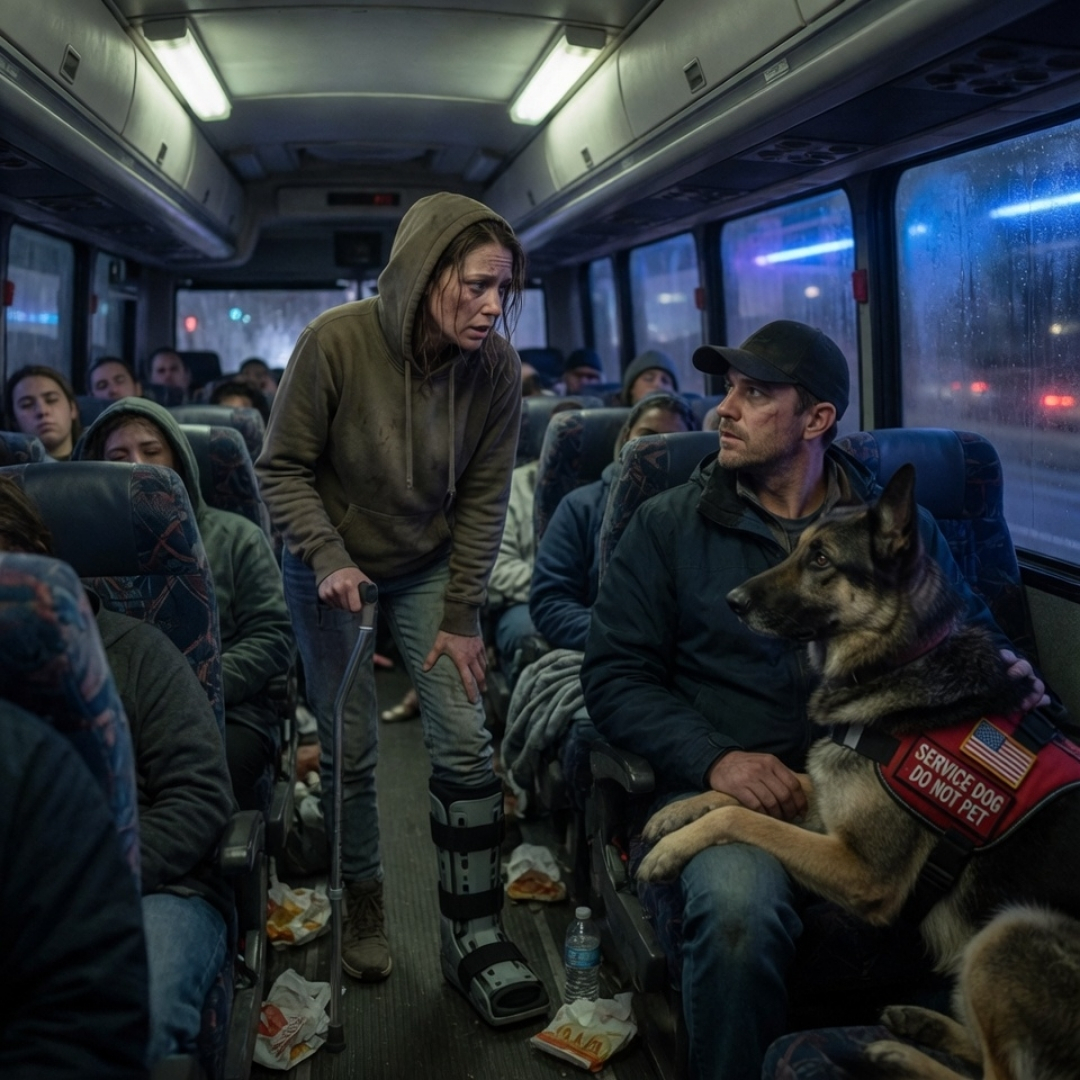
She stopped beside the seat, breathing hard.
“Excuse me,” she said, her voice hoarse. “Is this seat taken?”
The man lifted his head slowly. His eyes — a striking steel gray — took her in completely in one glance: the cane, the visible brace under her jeans, the way she was favoring her entire left side, the exhaustion etched into her face.
He didn’t speak immediately. Instead, he made a small, almost invisible hand signal with two fingers.
The German Shepherd named Atlas stood up gracefully, turned in a tight circle, and repositioned himself closer to his handler, tucking his powerful body neatly against the man’s legs and leaving exactly enough room for Sophia to sit comfortably.
The man gave a single nod.
Sophia lowered herself into the seat with a barely suppressed groan of relief. The moment her weight left her bad leg, tears pricked at the corners of her eyes.
“Thank you,” she whispered. “Really. Thank you.”
The man simply nodded once more. “Jack,” he said quietly.
“Sophia.”
That was the extent of their introduction for the first hour.
The bus rolled out into the desert night. The lights inside dimmed for sleeping passengers. Sophia leaned her head against the cool window and tried to breathe through the constant, burning pain. She hated this version of herself — the one who couldn’t even take a simple bus ride without calculating every movement.
She noticed Atlas watching her again.
The dog had turned his head and was staring directly at her with an intensity that felt almost human. His dark brown eyes were locked on her face. Every few minutes, he would lean forward and gently nudge her left thigh with his cold nose, then look up at her as if waiting for a response.
“Does he always stare like that?” Sophia finally asked, trying to keep her voice light.
Jack looked at his dog, then at her. “No. He doesn’t. Atlas is a fully trained medical alert and PTSD service dog. He alerts me when my heart rate spikes or when I’m about to have a flashback. But he rarely alerts to strangers unless he picks up something serious.”
Sophia felt a flicker of unease.
They talked in low voices as the miles passed. Jack was a former Navy SEAL who had served multiple tours in Afghanistan. He had his own scars — both visible and invisible. Atlas had been with him for three years, saving his life more than once when nightmares and heart issues collided.
Sophia told him a little about the fire. Not everything. Just enough.
Around 2:15 a.m., somewhere on a dark stretch of I-70 in eastern Utah, the pain changed.
It started as the familiar deep ache, but then her chest tightened painfully. Her heart began to race in an erratic, fluttering pattern she had felt before but never this violently. Cold sweat broke out across her forehead and back. Her vision started to tunnel at the edges.
Atlas suddenly stood up, his ears pricked forward. He let out a single sharp bark, then another.
Jack’s entire demeanor changed. “Sophia? Talk to me. What are you feeling right now?”
“My… my chest,” she gasped. “It’s racing. I feel like I’m going to pass out.”
Atlas began pawing urgently at her chest and arm, then nudging her face insistently. His barking became louder, more frantic — the kind of bark that demanded immediate attention.
Passengers around them started waking up, murmuring in confusion.
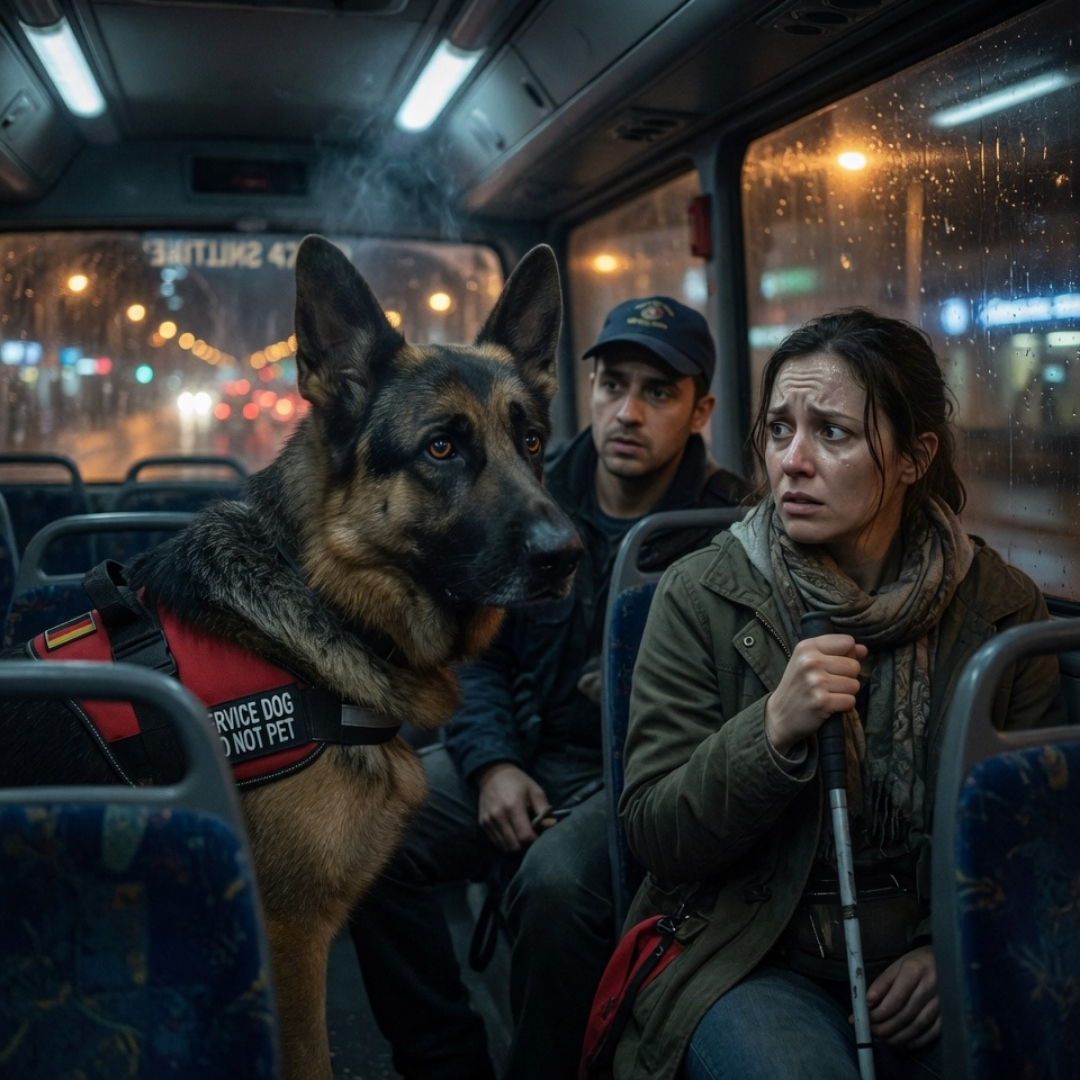
Jack moved with trained efficiency. He gently but firmly pushed Sophia’s head down between her knees. “Slow, deep breaths. Atlas is medical alerting. He’s telling me your vitals are crashing. Have you had heart issues since the injury?”
Sophia could barely nod. The doctors had warned her about possible complications — scar tissue affecting her heart rhythm — but she had downplayed it, thinking she could handle the trip.
Atlas refused to stop. He kept barking, nudging, and pawing at her until the bus driver pulled over at the next emergency turnout.
Jack stayed right beside her the entire time, one hand on Atlas, the other steadying Sophia. The big dog never left her side, continuously alerting until the paramedics arrived twenty minutes later at the remote rest stop.
Sophia was stabilized on scene and rushed to the nearest hospital in Grand Junction.
She woke up the next morning in a hospital bed with monitors beeping softly around her. Jack and Atlas were sitting quietly in the corner chair.
Atlas immediately walked over, placed his big head on the edge of the bed, and looked up at her with those same knowing eyes.
Tears slipped down Sophia’s cheeks as she reached out to pet him.
“You knew,” she whispered. “You knew before I did.”
Jack stood up and approached the bed. “Atlas has saved my life three times. Last night, he decided to save yours too.”
Over the next few days, as Sophia recovered, Jack visited every day. They talked about pain, about starting over, about the strange ways life brought people together on long bus rides.
When she was finally discharged, Jack drove her the rest of the way to Denver with Atlas sitting proudly between them in the truck.
As they crossed the Colorado state line, Sophia looked out at the mountains and felt something she hadn’t felt in a very long time — hope.
She had boarded that bus broken and terrified.
She got off it alive, seen, and no longer alone.
All because a service dog refused to stop staring at the woman with the cane.