They Humiliated the Quiet ER Nurse for Months—Until a Storm Rescue Helicopter Screamed for “Shadow” by Name and the Entire Hospital Froze
The first time they laughed at Nurse Lila Harper, she had blood on her scrubs and a dying teenager’s pulse under her fingers.
Nobody noticed that part.
They noticed the medication scanner.
It beeped red for the third time in a row under the harsh fluorescent lights of the emergency department at Riverside General Hospital in Portland, Oregon. The sound cut through the chaotic nurse’s station like a punchline waiting to land. Lila stood still in her dark blue scrubs, her pale face calm, her auburn hair pulled into a tight bun, her hands steady around the vial of medication.
A few feet away, Charge Nurse Vanessa Kline leaned against the counter with a paper coffee cup in her hand and a smile that was too sweet to be kind.
“Careful, Lila,” Vanessa said loudly enough for the whole station to hear. “That scanner has a lot of buttons. One whole button, actually.”
The nurses at the station laughed.
Lila did not.
She turned the vial a quarter inch, rescanned it, waited for the correct tone, and documented the dose with quiet precision. Her movements were careful, almost deliberate. That was what people said about her. Slow. Strange. Stiff. A charity hire. A nurse who looked like she was always waiting for bad news.
The truth was that bad news had followed Lila across two continents, through three combat deployments, and all the way back to this rain-soaked city in the Pacific Northwest. It had ridden beside her in Black Hawk helicopters. It had screamed through headsets. It had bled into her gloves while she fought to keep soldiers alive under fire.
At Riverside General, nobody knew that.
At Riverside General, she was just the quiet nurse Vanessa had decided to break.
“Dr. Hargrove wants to see you after this,” Vanessa added, lowering her voice but not enough to hide the poison. “Try not to look so terrified. It makes the patients uncomfortable.”
Lila’s eyes lifted for half a second.
Vanessa’s smile faltered.
There was something in Lila’s stare that didn’t belong in a community hospital. Something empty and controlled, like a storm cellar door bolted shut from the inside. Then Lila looked away, picked up the tray, and walked toward Room Four.
The patient inside, seventy-eight-year-old Harold Kemp, was struggling for breath. His daughter stood by the window crying into her sleeve. Lila adjusted the oxygen, checked his lungs, repositioned him gently, and spoke in a voice soft enough that the old man’s panic began to ease.
“You’re not drowning, Mr. Kemp,” she said. “Your lungs are working. I’m going to help them work better.”
His trembling hand caught hers.
“Don’t leave,” he whispered.

“I’m right here.”
In the hallway, laughter rose again from the nurse’s station.
Lila heard it. Harold’s daughter heard it too. Her face tightened with confusion and quiet anger on Lila’s behalf. Lila pretended not to notice.
Pretending had kept her alive once.
By 1:17 a.m., the emergency department had become the usual Saturday-night battlefield: drunk college students from the coast, a woman with a broken wrist from a domestic dispute, a teenager vomiting after too much whiskey, and a fisherman with a hook buried deep in his palm. Lila moved through them all without drama, without complaint, without the warm performance Vanessa called “proper bedside presence.”
Then Dr. Calvin Hargrove called her into his office.
He did not ask how her shift was going. He tapped a folder on his desk and said, “Lila, I’m concerned.”
She sat across from him, spine straight.
“Your charting speed is below department average,” he said. “You don’t engage well with staff. Vanessa tells me other nurses are hesitant to work with you.”
“I haven’t made a single medication error in six months,” Lila replied.
“No,” Dr. Hargrove admitted. “But emergency nursing is not only about avoiding errors. It’s about teamwork. About fitting in.”
Lila looked at the rain streaking his window. Outside, the storm had begun to crawl down from the Cascade foothills, dragging heavy wind behind it.
Dr. Hargrove sighed. “We need people who can handle pressure, Lila.”
For the first time, something almost like a smile touched Lila’s mouth.
It disappeared before he understood it.
“I understand,” she said quietly.
“Do you?” He leaned forward. “Because I’m putting you on a thirty-day performance improvement plan. If we don’t see real change, we’ll have to discuss termination.”
Termination.
The word should have scared her.
It didn’t.
What scared her was how tired she felt. How six months of whispered jokes, reassigned trauma cases, and fake concern had done what roadside bombs had not. They had made her question her own hands.
She left his office and returned to work. Vanessa was waiting at the nurse’s station with a triumphant little smile.
“So?” Vanessa asked. “How bad was it?”
Lila logged into the computer without answering.
Vanessa stepped closer. “You know, this would be easier if you just admitted you’re not built for this place.”
Lila’s fingers stopped over the keyboard.
Then the radio cracked open.
The entire emergency department went still.
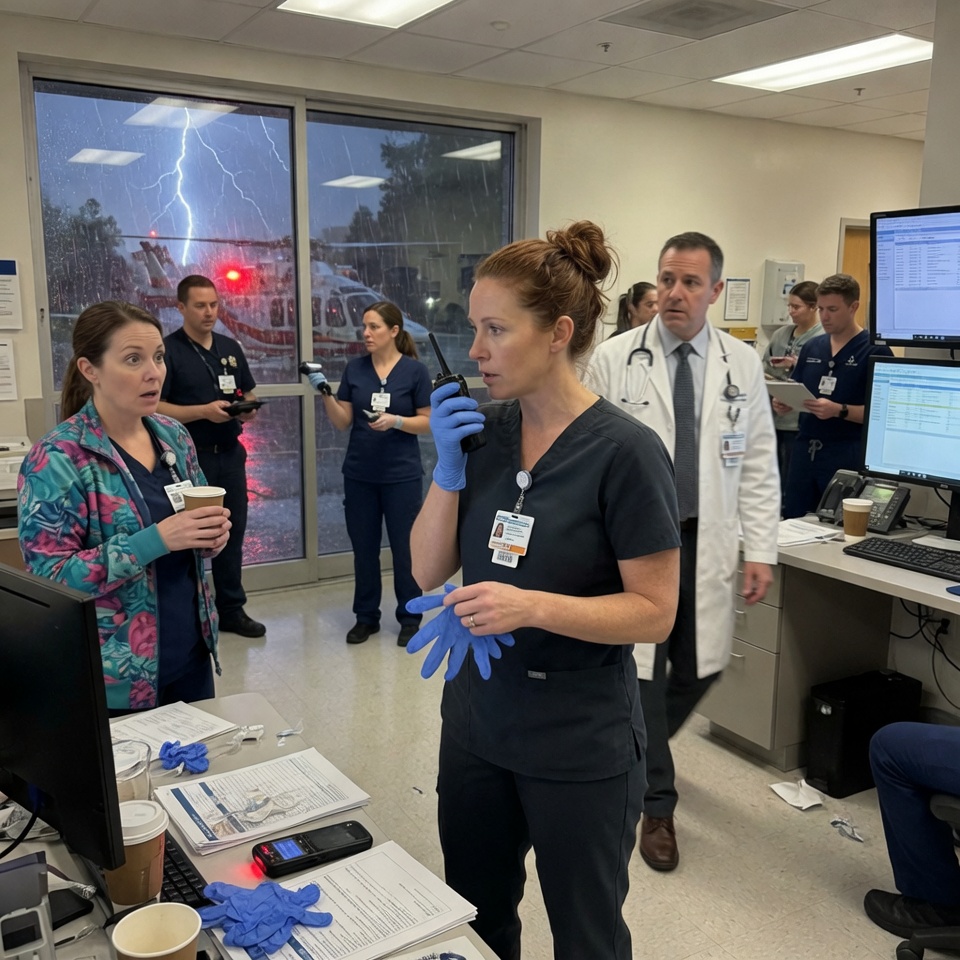
“Riverside General, this is LifeFlight Two-Seven. We are inbound through severe storm conditions with one critical trauma patient. Male, twenty-six. Logging accident. Massive blood loss from suspected femoral artery severance. Tourniquet failing. ETA eight minutes.”
Vanessa grabbed the radio first. “LifeFlight Two-Seven, copy. Divert to Portland Trauma Center if unstable.”
A burst of static. Then the pilot’s voice came back, strained and urgent.
“Negative. Portland is too far. He’ll code before we clear the ridge. We need Riverside ready for immediate surgical intervention.”
Dr. Hargrove appeared behind Vanessa, his face pale. “Ask them current vitals.”
Vanessa keyed the mic. “Two-Seven, current blood pressure?”
“Fifty over palp. We lost pulse twice en route. We need advanced trauma support immediately.”
Dr. Hargrove went white. “We can’t handle that level of trauma here. We’re not equipped—”
The radio hissed again.
Then the pilot said seven words that changed the entire hospital.
“Is Nurse Shadow on duty tonight?”
Vanessa frowned. “Who?”
The voice sharpened with desperation.
“Call sign Shadow. Lila Harper. Former Army combat medic. If she’s in that building, put her on the radio right now.”
Every head in the department turned toward Lila.
Vanessa stared at her like she had suddenly become dangerous.
Dr. Hargrove whispered, “Lila?”
The radio crackled again.
“Riverside General, we are losing him. I need Shadow.”
Lila walked slowly to the station. Her hand closed around the radio. When she spoke, her voice changed. It became colder. Stronger. Commanding in a way none of them had ever heard.
“This is Shadow,” she said. “Talk to me.”
And on the other end of the storm, a helicopter full of blood and desperation answered like it had just found its last hope.